Cause Marketing: How to Run a Campaign That Helps a Cause and Protects Your Margin
Plan a cause-linked promotion: understand contribution mechanics, check UK rules, estimate break-even and test commercial results without overstating them.
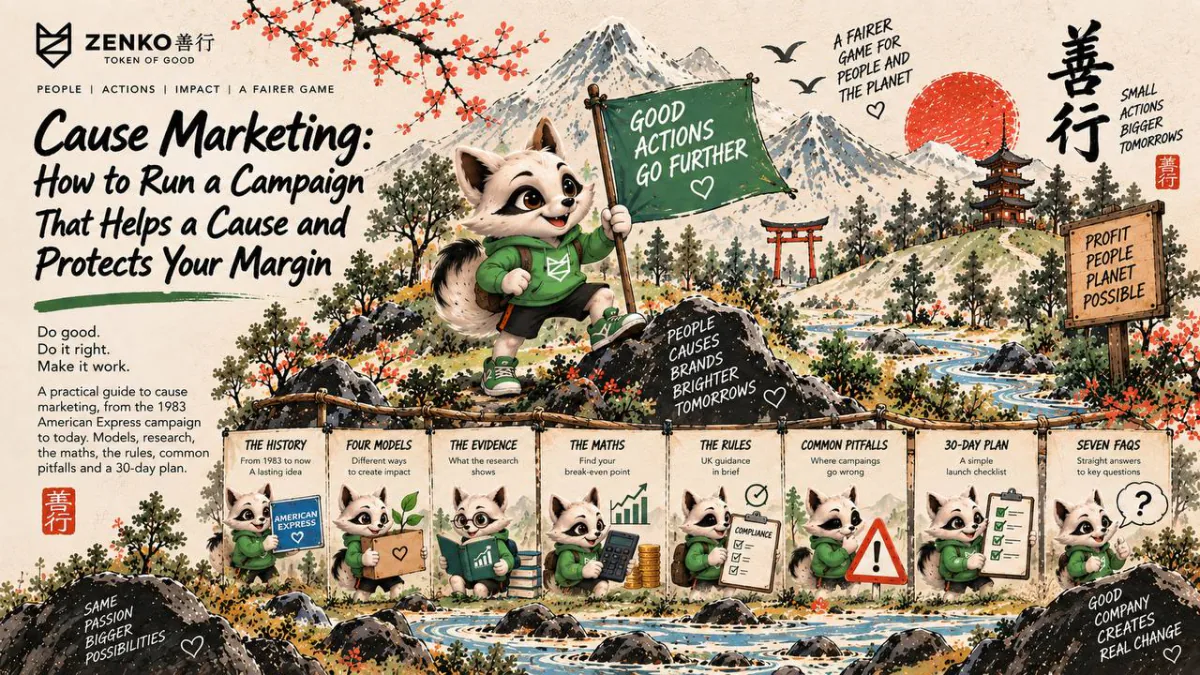
Cause marketing is a promotion where a business commits to support a named cause when customers take part, usually by buying. The business gives customers another reason to choose it; the cause receives the promised support. Neither extra sales nor additional social benefit should be assumed without evidence.
The promise needs to be specific, the maths needs to hold and you need to show what reached the cause. This guide covers the models, research, UK rules, donation economics and measurement. To test the numbers before you commit, use the free Cause Marketing Calculator. Its calculations and generated wording are planning aids, not campaign approval.
Where cause marketing came from
Varadarajan and Menon's 1988 Journal of Marketing paper is a foundational academic account of cause-related marketing. Its transaction-linked conception centres on a business offering a specified contribution to a designated cause when customers buy. This is a paraphrase, not a quotation from an independently checked definition page. Here we also discuss related customer-action models, while distinguishing unconditional corporate donations and employee volunteering.
American Express's 1983 Statue of Liberty restoration promotion is a well-known early example. A contemporary Christian Science Monitor report, published on 11 October 1983, says the company would donate one cent for each US purchase charged to an American Express card and each purchase of American Express Travelers Cheques, through 31 December. That documents the promise and its end date. It does not establish that the campaign was the first of its kind or prove its effect on card use.
The four models
These four forms of business support are often grouped together, but they are not all cause-related marketing in the narrow transaction-linked sense.
A donation tied to a sale. The business gives a fixed amount per sale, a percentage of price or a defined percentage of gross profit. A guaranteed minimum can increase the contribution. A budget cap can be modelled, but it is not automatically acceptable in a per-purchase advertising promise: see the CAP restrictions below.
A time-limited fundraising partnership. A brand and a charity run a campaign for a set period, such as in-store fundraising or a product line supporting an appeal. Whether it is transaction-linked cause marketing depends on the actual mechanism. Agree use of the charity's name and the contribution terms.
Employee or volunteer activity. Staff give time, skills or payroll donations. This is an adjacent partnership activity, not automatically purchase-contingent cause-related marketing. Its legal treatment depends on the arrangement and representations; public claims still need evidence.
Verified customer action. Zenko describes Shop for Good as connecting an eligible purchase to a separately funded outcome delivered by a named local partner, with a record of customer participation. Its verified-action model checks that a specified purchase, course or activity happened before releasing a reward. These are related mechanisms, not proof that every action automatically produces a charitable outcome. The funder, eligibility rules, contribution and delivery evidence need to be agreed for each programme. A non-purchase action model needs case-specific legal assessment; it is not automatically covered or exempt merely because an action is verified.
What the research says about whether it works
Results vary substantially. A 2023 meta-analysis abstract reports 237 studies, a moderate average effect on attitudes (d = 0.458) and a smaller average effect on behavioural responses (d = 0.283), with high variation between studies. These are standardised effect sizes, not percentage sales lifts. The authors identify the visual prominence of the donation as the strongest individual moderator of behavioural responses; priorities for attitudes and behaviour differ.
A separate 2024 field-study abstract reports 63 cause-related promotions across 20 fast-moving consumer goods categories, an average weekly sales lift of 4.9%, an average donation of 3.2% of product price and an average duration of 11 weeks. These sample averages are not a forecast for your brand or a recommended donation rate. In a later American Marketing Association interview, the researchers stress that results vary widely and some campaigns substantially outperform the average.
The claims here are confined to the verified original abstracts and the separately attributed public interview, not a full-paper methods review. Do not confuse a plausible brand story with a sound partnership. In the AMA interview, the researchers describe a preliminary, subjectively coded analysis suggesting small brand-cause-fit effects. They explicitly say it was excluded from the published field-study paper because interpretation was difficult. It does not establish that fit is unimportant or that governance matters more in a measured sales model.
If a donation and a discount launch together, a before-and-after comparison cannot separate their effects. Where volume permits, randomise between no offer, donation only, discount only and both; otherwise report the combined offer's result. The authors' finding that price promotions can complement cause promotions is not permission to attribute the whole combined lift to the donation. Broad consumer purchase-preference claims are not needed to make the business case.
Choosing a cause and a partner
Pick a cause customers can understand and a partner whose identity, governance, delivery capacity and contribution reporting you can verify. Consider fit and reputational risk together. Our guides on why people support causes, how people choose a cause and local vs global causes cover the audience side. Corporate Charity Partnership: How to Choose a Charity Partner covers due diligence and relevant UK registers.
CAF's 2026 UK Giving release estimates that the British public donated £14 billion in 2025, compared with £15.4 billion in 2024. It reports giving participation falling from 69% in 2016 to 55% in 2025. These are charitable-giving estimates, not a survey showing that cause-linked products increase sales. A dependable corporate contribution can matter to a charity, but commercial return needs a separate test.
The maths in plain English
Every charity promise has a price. Before launch, calculate how many extra sales would repay the donation and other campaign costs.
These are hypothetical planning examples, not campaign results. Prices exclude VAT and sales tax. Gross margin is a percentage; multiplying it by the net price gives estimated gross contribution per sale before campaign costs, overheads and tax. The calculator rounds that contribution and each percentage-based donation to the nearest penny per unit. It treats the donation as a straight cost, with no tax adjustment.
Take a £40 net-price product with a 50% gross margin: £20 gross contribution per sale. You expect 5,000 sales without the campaign. You promise £1 per sale to a charity and spend £2,000 running the campaign, with no cap or minimum.
- Gross contribution per sale after the donation: £19.
- Donation at 5,000 baseline sales: £5,000.
- Donation plus other campaign costs if sales do not move: £7,000.
- Extra sales needed: £7,000 ÷ £19 = 368.421..., rounded up to 369.
- Lift required: 7.38%, or 7.4% rounded.
With no binding cap or minimum, extra sales needed = (campaign cost + donation on baseline sales) ÷ (gross contribution per sale − donation per sale), rounded up to a whole sale. This assumes positive contribution after donation and that baseline sales would have happened anyway.
A cap or minimum requires a piecewise calculation. For total sales N, baseline B, unit gross contribution g, unit donation d, campaign cost K, minimum m and cap c, the donation is D(N) = max(m, min(c, d × N)), with 0 ≤ m ≤ c and no cap represented by c = ∞. Below the floor D(N) = m; between floor and cap D(N) = d × N; above the cap D(N) = c. Find the smallest whole N ≥ B for which (N − B) × g − D(N) − K ≥ 0. That is incremental campaign contribution, not net profit; the cap does not stop sales.
Enter prices before VAT or sales tax. For a £25 VAT-inclusive price at 20% VAT, enter £20.83 to the nearest penny. At 40% gross margin, the calculator uses £8.33 unit contribution; a 5% donation on that net price rounds to £1.04 per unit. If the public promise is instead 5% of the VAT-inclusive £25, the donation remains £1.25: enter that fixed amount and make the basis explicit. Do not silently change the customer's promise when removing VAT. Ask your accountant which treatment applies.
| Donation basis | What it means | Planning consideration |
|---|---|---|
| Fixed amount per sale | Same monetary amount at any price | Easy to cost; can be expensive on low-priced items |
| Percentage of price | Unit donation varies with the defined price; total also varies with units sold | Can consume much of a thin gross contribution |
| Percentage of gross profit | A stated share of a clearly defined gross-profit amount | More sensitive to gross-profit assumptions; not a guarantee of net profitability |
A cap limits the modelled donation, not all campaign losses. A minimum guarantees a contribution floor. They change break-even only when they bind. CAP requires relevant limits to be disclosed but also restricts consumer-contribution cut-offs under per-purchase claims. How Much Should You Donate Per Sale? covers the 369-sale example, a hypothetical 450-sale capped versus 458-sale uncapped example, and a 106-sale example with a nonbinding floor, plus a genuinely binding-floor example. Calculator wording is not an approved advertisement.
The rules in brief for the UK
This is general information, not legal advice or solicitor approval. The detail is in Commercial Participators: The UK Rules for Charity-Linked Sales.
- England and Wales: assess the statutory test. Section 58 of the Charities Act 1992 covers a person carrying on a business for gain, other than a fundraising business, who runs a promotional venture representing that charitable contributions will benefit a charitable institution. Companies connected with the institution are excluded. Merely mentioning a charity, sponsoring its event or describing charitable work is not automatically enough. Assess the actual contribution arrangement and the full express or implied message. A charitable institution can include an institution established for charitable, benevolent or philanthropic purposes, not only a registered charity. General charitable purposes can also carry statement obligations under regulation 7, as amended in 2009; leaving a charity unnamed is not a workaround.
- Agreement and statement. Where that test is met, a compliant signed written agreement is required before the qualifying representation, under section 59 and regulation 3. Section 60 requires beneficiary identification, applicable splits and the actual notifiable charitable amount, or an estimate calculated as accurately as reasonably possible. That amount is not the commercial participator's own remuneration. Section 60(5) covers oral representations made neither face to face nor on radio or television: within seven days of a responsive payment of £150 or more, the payer must receive the required written information and cancellation/refund rights. Broadcast/card-payment representations have a separate rule. These are payment thresholds, not fines or minimum donations.
- Changes and penalties. SI 2026/427, effective 30 September 2026 in England and Wales only, raised specified section 60/61 thresholds from £100 to £150. Transitions preserve old requirements for specified earlier payments, representations and agreements; campaign launch date alone does not settle the position. Statement breaches can attract an unlimited fine under later fine legislation for relevant offences from 12 March 2015, subject to statutory defences. Agreement failures have separate injunction and contract-enforcement consequences.
- Scotland. The 2009 Regulations require a compliant signed written agreement. Basic information can be oral for an oral representation; specified further information must be available in writing on request. The £100 cancellation/refund rules have their own conditions and timings, not the English/Welsh seven-days-after-payment procedure. Specified breaches can attract a level 5 fine, described by OSCR as up to £5,000, subject to the reasonable-excuse qualification.
- Northern Ireland. As checked on 11 October 2026, sections 150 and 151 remain prospective. The Fundraising Regulator recommends following England/Wales or Scotland requirements as good practice. Advertising, consumer law and applicable fundraising standards still matter.
- Advertising. CAP rules 8.33 and 8.34 require naming each beneficiary, evidence of a formal agreement, and the nature and objectives of a beneficiary that is not a registered charity. Specify the benefit, calculation basis and relevant limits. Where part of the price is donated, state the actual amount or percentage of price; other charity-linked promotions must state the total contribution or a reasonable estimate. Do not exaggerate the benefit; provide a current or final total if asked. Rule 8.33.5 prohibits a consumer-contribution cut-off where an amount is stated for each purchase and requires money collected above a target to benefit the cause on the same basis. Disclosing a cap is not a safe harbour.
- Consumer law. Final CMA207 guidance, first published 4 April 2025 and updated 18 November 2025, explains the DMCC Act unfair-commercial-practices provisions applying from 6 April 2025. They replaced and updated the 2008 regulations. For misleading actions and omissions, the statutory conditions include likely effect on the average consumer's transactional decision. False or materially incomplete charity claims can breach these rules; the guidance does not approve a donation mechanic.
Where it goes wrong
Vague promises. A specific per-purchase amount or price percentage is easier to check than an unspecified donation. CAP guidance does not turn an isolated phrase into an approved campaign: beneficiary, basis, terms and applicable statutory information still matter.
Hidden limits and consumer cut-offs. A disclosed limit does not automatically make a capped every-purchase promise acceptable. Rule 8.33.5 needs to be checked against the actual mechanic. Ask CAP Copy Advice or a qualified adviser; do not copy a calculator's capped output straight into an advert.
Misleading presentation and missing agreement evidence. In its 12 October 2022 Raffleaid ruling, the ASA found that the name and presentation misleadingly suggested charitable fundraising was the primary purpose of all its draws. Separately, ads omitted required contribution information and the advertiser failed to provide evidence of a formal agreement with a beneficiary. This was not a ruling that every charity mention triggers the statutory commercial-participator test.
Giving that misses the need. A TOMS-supported cluster-randomised trial covered 1,578 children in rural El Salvador, where most already owned shoes. The 2016 World Bank working-paper version reports generally insignificant health and self-esteem effects, small positive school-attendance effects for boys, and a negligible overall effect in that setting. That is a targeting warning, not proof that every TOMS programme failed. TOMS's current company story says a portion of profits supports children's education, health and wellbeing through grants, product donations and partnerships; do not substitute the historical one-for-one or one-third promise. See cause marketing examples.
Greenwashing. Environmental cause claims also need to satisfy applicable environmental-claims rules. See carbon offsetting and greenwashing.
How to tell whether it worked
Keep three questions apart: did promised support reach the cause, did sentiment change, and did sales exceed what would have happened anyway? Evidence for one does not by itself establish the others. Zenko reports 2,000 meals' worth of fresh produce delivered through MK Dons Shop for Good. That is a reported delivery quantity, not meals eaten, children permanently supported or additional shirt sales.
A before-and-after sales comparison describes change, not necessarily causation. A holdout needs randomisation or defensible quasi-experimental assumptions; choosing one comparison region is not automatically a sound geo test. HM Treasury's evaluation guidance explains why credible counterfactual design matters. Compare estimated incremental sales and their uncertainty with break-even. If the uncertainty interval spans that threshold, the test does not clearly establish payback. How to Measure Cause Marketing Without Fooling Yourself, rewards measurement and rewards-based marketing develop the approach.
A 30-day launch checklist
Legal requirements depend on scope and jurisdiction. Timing and workflow below are good-practice suggestions, not clearance to launch.
Days 1 to 7: decide
- Set a primary objective: sales, new customers, retention or reputation.
- Model the donation, baseline, break-even and downside if sales do not move. Treat any cap as a budgeting scenario pending advice.
- Shortlist partners and check relevant Charity Commission, OSCR or CCNI records. Absence from a register is not automatically misconduct: some legitimate charities are small, excepted or exempt. Verify identity and legal status.
Days 8 to 14: agree 4. Agree the contribution basis, any minimum and proposed limits, period, reporting and exit. 5. Assess the statutory commercial-participator test. If it applies in England and Wales, sign a compliant agreement before the qualifying representation; a charity mention alone is not the trigger. Regulation 3 and section 59 require parties, addresses, signing dates, duration and termination/variation terms, objectives and methods, contribution types and triggers, calculation and any multi-institution split, remuneration/expenses, any voluntary standard undertaken, public protection and monitoring. Other jurisdictions and CAP's formal-agreement requirement need separate checks. 6. Take advice on the agreement and exact claim. The 1994 Regulations' official changes record lists amendments to regulations 1, 6 and 7; no regulation 3 change was listed when checked on 11 October 2026. Read regulation 3 alongside section 59(7) and (8), not in isolation.
Days 15 to 21: word and prepare 7. Identify each beneficiary, the benefit, calculation basis, relevant limits and applicable actual or carefully estimated charitable amount. A price percentage is not a gross-profit percentage. 8. Check CAP 8.33 and 8.34, including the 8.33.5 cut-off restriction, and applicable statutory statements. A percentage alone is not universally sufficient. 9. Record sales, contribution liabilities, payments and dates; pre-specify a credible evaluation design.
Days 22 to 30: launch and record 10. Launch only after the necessary approvals. Be ready to provide the current or final contribution total if asked. 11. Retain the baseline and comparison plan, including uncertainty, rather than treating observed sales as incremental sales. 12. Agree payment timing and what receipt or delivery report will substantiate the promise.
Plan the numbers with Zenko
The Cause Marketing Calculator models break-even using fixed donations, percentages of net price or a simplified gross-profit proxy, with an optional cap and guaranteed minimum. It is not a net-profit forecast, tax calculation or legal approval of its generated customer wording. For programme-specific verified customer actions, start at For Brands.
FAQs
What is cause marketing?
Cause marketing links customer participation, usually a purchase, to promised support for a named cause. The narrower academic conception is transaction-linked. Unconditional corporate donations and employee volunteering are adjacent activities, not automatically the same model. See the foundational paper's bibliographic record.
Is cause marketing the same as cause-related marketing?
The terms are often used interchangeably in business writing. The original academic conception of cause-related marketing is narrower, linking a specified contribution to a customer's revenue-producing transaction. This guide also covers related customer-action promotions and labels adjacent activities separately.
What was the first cause marketing campaign?
The source reviewed here does not establish a first campaign. American Express's 1983 Statue of Liberty promotion is a well-known early example. A contemporary report documents its one-cent qualifying-purchase promise through 31 December, not its priority or causal sales effect.
Does cause marketing increase sales?
Results vary. A 2024 field-study abstract reports a 4.9% average weekly sales lift across 63 promotions; a 2023 meta-analysis abstract reports larger average effects on attitudes than behavioural responses. These are different measures, not a forecast or guaranteed return. This summary is abstract-based, not a full-paper review.
Do I need a written agreement with the charity?
If your promotion falls within England and Wales commercial-participator rules, you need a compliant signed written agreement before the qualifying representation. Scotland also requires a compliant signed agreement. Northern Ireland's equivalent provisions remain prospective; the Fundraising Regulator recommends following England/Wales or Scotland requirements as good practice. Advertising rules and applicable fundraising standards may also require a formal agreement. Merely mentioning a charity does not automatically satisfy the statutory test.
How much should a business donate per sale?
There is no universal right amount. Model unit gross contribution, baseline sales, donation and other campaign costs. The 2024 study abstract's 3.2% average donation is context, not a recommendation. Caps or minimums require piecewise arithmetic when they bind; a calculator result does not approve a capped per-purchase advertisement.
What are the risks of cause marketing?
Risks include insufficient incremental contribution, misleading or unsupported claims, missing required agreements or statements, unsuitable contribution terms, and support that fails to meet the intended need. Clear terms, partner checks and credible delivery and sales evidence reduce risk; they do not guarantee payback or legal compliance. CAP rules and the applicable statutory regime still need checking.
Sources
Sources checked 11 October 2026. Research scope is stated above; no full-paper or solicitor review is claimed.
- Varadarajan and Menon (1988), Journal of Marketing 52(3), 58–74. Bibliography/DOI, not an independently checked quotation page: https://doi.org/10.1177/002224298805200306
- Christian Science Monitor, 11 October 1983: https://www.csmonitor.com/1983/1011/101147.html
- Schamp et al. (2023), Journal of Marketing Research 60(1), 189–215. Verified abstract: https://research.rug.nl/en/publications/e27de894-3b20-47b7-a3bf-53e080a093ee/
- Schamp et al. (2024), Journal of Marketing Research 61(5), 955–974. Verified abstract: https://research.vu.nl/en/publications/c794eb2b-96ad-4608-9ffc-e8137f51d15e
- AMA, researcher interview, 25 September 2025: https://www.ama.org/2025/09/25/do-good-sell-more-can-cause-related-marketing-promotions-boost-product-sales/
- CAF, public release, 16 March 2026: https://www.cafonline.org/home/about-us/press-office/amount-donated-by-british-public-falls-for-first-time-in-five-years
- Charities Act 1992, sections 58–61: https://www.legislation.gov.uk/ukpga/1992/41/section/58 ; https://www.legislation.gov.uk/ukpga/1992/41/section/59 ; https://www.legislation.gov.uk/ukpga/1992/41/section/60 ; https://www.legislation.gov.uk/ukpga/1992/41/section/61
- 1994 Regulations, regulation 3 and effects record: https://www.legislation.gov.uk/uksi/1994/3024/regulation/3/made ; https://www.legislation.gov.uk/changes/affected/uksi/1994/3024 ; 2009 amendment: https://www.legislation.gov.uk/uksi/2009/1060/made
- SI 2026/427: https://www.legislation.gov.uk/uksi/2026/427/made
- Fine legislation and commencement: https://www.legislation.gov.uk/ukpga/2012/10/section/85 ; https://www.legislation.gov.uk/uksi/2015/504/article/2/made ; https://www.legislation.gov.uk/uksi/2015/664/made
- Scotland 2009 Regulations: https://www.legislation.gov.uk/ssi/2009/121/made ; OSCR penalties: https://www.oscr.org.uk/managing-a-charity/fundraising/charities-and-benevolent-fundraising-scotland-regulations-2009-guidance/offences-and-penalties/
- Northern Ireland prospective provisions: https://www.legislation.gov.uk/nia/2008/12/section/150 ; https://www.legislation.gov.uk/nia/2008/12/section/151
- Fundraising Regulator, Code section 6: https://www.fundraisingregulator.org.uk/code/standards-which-apply-working-others/fundraising-partnerships
- CAP, Code section 8: https://www.asa.org.uk/type/non_broadcast/code_section/08.html ; charity-linked promotions guidance, 4 February 2026: https://www.asa.org.uk/advice-online/promotional-marketing-charity-linked-promotions.html
- CMA, final CMA207, first published 4 April 2025, updated 18 November 2025: https://www.gov.uk/government/publications/unfair-commercial-practices-cma207/unfair-commercial-practices
- ASA, Clarson Ltd t/a Raffleaid, 12 October 2022: https://www.asa.org.uk/rulings/clarson-ltd-a22-1148028-clarson-ltd.html
- TOMS trial: 2016 World Bank working-paper version, WPS7822, supported by TOMS; relevant abstract/discussion, not full 2018 journal paper: https://documents1.worldbank.org/curated/en/960091473863696457/pdf/WPS7822.pdf ; current company story: https://www.toms.com/pages/about-toms
- Zenko planning calculator: https://www.zenkoprotocol.com/cause-marketing-calculator/ ; programme descriptions: https://www.zenkoprotocol.com/insights/how-shop-for-good-works/ ; https://www.zenkoprotocol.com/insights/verified-real-world-actions/
- HM Treasury, Quality in Policy Impact Evaluation: https://www.gov.uk/government/publications/the-magenta-book/quality-in-policy-impact-evaluation-qpie-html
This article is general information, not legal, tax or financial advice. Rules change; check the current position and take campaign-specific advice before launch.