Commercial Participators: The UK Rules for Charity-Linked Sales
Commercial participator agreements, statements, payment thresholds and penalties: how England and Wales, Scotland and Northern Ireland differ.
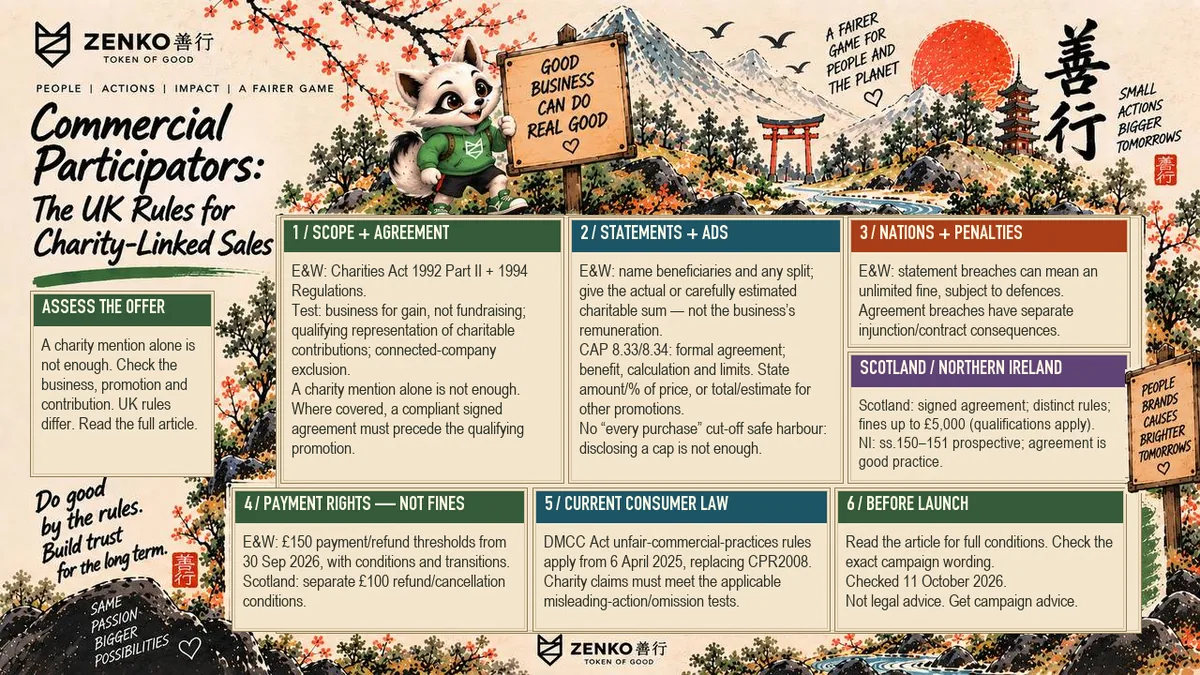
A donation-linked sales promotion can make a business a commercial participator. In England and Wales, a business that meets the statutory test needs a compliant signed agreement before making the qualifying representation, and must provide specified information with that representation. Merely mentioning a charity does not automatically trigger the regime. Scotland has separate rules; Northern Ireland's equivalent agreement and statement provisions remain prospective.
This guide explains those distinctions, with links to the legislation and regulator guidance. Sources were checked on 11 October 2026. It is general information, not legal advice, solicitor approval of campaign wording or a substitute for review of your agreement. It is part of our wider guide to cause marketing.
Are you a commercial participator?
In England and Wales, section 58(1) of the Charities Act 1992 defines a commercial participator in relation to a charitable institution as a person, apart from a company connected with the institution, who:
- carries on for gain a business other than a fundraising business, and
- in that business, engages in a promotional venture representing that charitable contributions are to be given to or applied for the benefit of the institution.
The same section defines a promotional venture broadly, including advertising, sales campaigns and other ventures undertaken for promotional purposes. A representation can be express or implied. Assess the complete message and the actual contribution arrangement, not just the label on the campaign or the presence of a logo.
Charitable contributions include relevant sales consideration, promotional proceeds and donations connected with the sale or supply of goods or services. A fixed donation per sale, a percentage of price or a percentage of profit can therefore fall within the rules. Non-purchase action schemes and platform arrangements need case-specific assessment against all the definitions; the breadth of “promotional venture” alone does not settle their status.
A charitable institution is not necessarily a registered charity: section 58 includes institutions established for charitable, benevolent or philanthropic purposes. Promotions supporting general charitable purposes rather than a named institution can still have statement obligations under regulation 7 of the 1994 Regulations, as amended by SI 2009/1060. Leaving a beneficiary unnamed is not a workaround.
A straightforward donation does not by itself make its donor a commercial participator. Merely mentioning a charity, sponsoring an event or describing charitable work does not automatically satisfy the test. The Fundraising Regulator's guidance explains the category and exclusions. Other advertising, fundraising and consumer-law duties may still apply.
England and Wales: what the law requires
1. A written agreement before the qualifying representation
Section 59(2) makes it unlawful for a commercial participator to represent that charitable contributions will benefit an institution except in accordance with an agreement satisfying the prescribed requirements. This is not a blanket prohibition on unrelated copy that names a charity.
For an England and Wales commercial participation agreement, regulation 3 of the 1994 Regulations and section 59(7) and (8) require:
- a written agreement signed by or on behalf of both parties
- the parties' names and addresses and their signing dates
- the duration and any termination or variation terms
- the principal objectives and methods
- the types of contribution and circumstances in which they arise
- how the charity's share or donation is calculated and, where several institutions are parties, how it is divided
- any remuneration or expenses payable to the commercial participator and how they are calculated
- details of any voluntary fundraising scheme or standard the business undertakes to follow
- how vulnerable people and the public will be protected from unreasonable intrusion on privacy, unreasonably persistent approaches and undue pressure to give money or other property
- arrangements enabling the charity to monitor compliance.
The last three requirements in section 59 must be read alongside the Regulations. Specifying any voluntary standard undertaken does not mean the statute compels adoption of a particular voluntary scheme. The Fundraising Regulator says the compliant agreement must precede the promotion and the charity must monitor compliance for its duration.
A non-compliant agreement is not enforceable against the charity except to the extent a court orders. Remuneration or expenses are payable only where the agreement provides for them and meets the prescribed requirements, or the relevant provision takes effect under a court order. Section 59(3) provides for an injunction on the charity's application where the breach is likely to continue or recur. These are the agreement regime's enforcement and contract consequences under section 59(3)–(5); they do not bar separate advertising or consumer-law enforcement.
2. A statement with each qualifying representation
Section 60(3) requires a statement clearly indicating:
- the name or names of the charitable institutions concerned
- if more than one benefits, the proportions in which they benefit
- the applicable notifiable amount.
For a commercial participator, section 60(3)(c) concerns the sales consideration, other promotional proceeds or sale-linked donations that will benefit the institution. It is not the commercial participator's own remuneration. Section 60(3A) requires the actual amount if known, otherwise an estimate calculated as accurately as reasonably possible in the circumstances. The remuneration wording elsewhere in section 60 concerns professional fundraisers.
CAP's advertising provisions are a separate layer. A percentage-of-price claim can be acceptable under CAP 8.34, but that does not remove the statutory information requirements. The percentage discussion below explains the distinction.
3. Oral and broadcast representations: payment thresholds, not fines
Section 60(5) applies to an oral representation made neither face to face nor during a radio or television programme. Within seven days of a payment of £150 or more made to the commercial participator in response, the payer must receive a written statement covering the section 60(3) information and the applicable section 61 cancellation and refund rights, subject to the transition rules below.
Section 60(4) separately covers radio or television representations associated with card-payment announcements and requires refund-right information for qualifying payments. These are payment and consumer-rights thresholds, not fines, cash-only triggers or minimum donation promises. The relevant sum is the payer's payment, not just the portion passed to the charity.
4. Penalties and enforcement
In England and Wales, breaching the section 60 statement requirements is a criminal offence. Although section 60(7) still says “level 5 on the standard scale”, section 85 of the Legal Aid, Sentencing and Punishment of Offenders Act 2012 removed the upper limit for relevant offences committed from 12 March 2015. Its commencement and exceptions are set out in SI 2015/504 and SI 2015/664. The latter's listed exceptions do not include Charities Act section 60.
For relevant current offences, the fine can therefore be unlimited, not £100, £150 or automatically capped at £5,000. Section 85 retains qualifications for under-18 defendants and earlier offences; this is not a claim that every defendant and offence date has the same maximum. Section 60(8) provides a defence of reasonable precautions and due diligence. Section 60(9) addresses an offence attributable to another person's act or default.
The separate section 59 agreement requirement is enforced through its injunction mechanism and has the contract and remuneration consequences described above. Do not confuse that mechanism with criminal statement offences or assume it excludes advertising and consumer-law action. Scotland's separate offences and level 5 fine are covered below.
What changed on 30 September 2026
SI 2026/427 came into force on 30 September 2026 and extends only to England and Wales.
- Article 2(3) raises the section 60(4) and (5) payment thresholds from £100 to £150. Article 2(5) makes corresponding changes to the section 61 cancellation and refund thresholds.
- Article 5(2) preserves the old section 60 requirements for payments of £100 or more made before 30 September 2026.
- Article 5(4) separately preserves the old section 61 rules for qualifying payments or agreements responding to solicitations or representations made before that date. The relevant event is not simply when a campaign launched.
- Article 2 raises the section 58(3) professional-fundraiser remuneration figures from £10 to £15 per day and from £1,000 to £1,500 per year or venture, and changes corresponding lower-paid-collector figures in section 60B. These changes do not redefine commercial participators.
- Charity accounting thresholds also changed, with article 5(6) applying the new figures to financial years ending on or after 30 September 2026. See the exact income, asset and legal-form tests in our partnership guide.
The Order does not change Scottish or Northern Irish thresholds. Some guidance, including the Fundraising Regulator's commercial-participator page, still contains the older £100 England and Wales remote/broadcast figure. For these points, follow the current legislation and its transitions, not that older passage.
Scotland
The Charities and Benevolent Fundraising (Scotland) Regulations 2009, made under the Charities and Trustee Investment (Scotland) Act 2005, have their own requirements. Regulation 2 requires a compliant agreement in writing, signed by or on behalf of both parties. OSCR's agreement guidance explains that fundraising without the required agreement can be an offence.
The information rules are not a universal written-statement requirement:
- Regulation 3 requires information identifying the benevolent body, any split between bodies and whether the fundraiser or commercial participator is remunerated. Regulation 3(2) permits the basic information to be given orally where the representation is oral.
- Regulation 4 adds information about the commercial participator's remuneration method and the applicable notifiable sum. For oral representations, the customer must be told that the information is available in writing. It must be provided on request, immediately in person or as soon as reasonably possible remotely.
- Regulations 3 and 5 contain specified £100 refund and cancellation rules with their own conditions and time limits. Under regulation 5, written notice is generally required within seven days of the representation. Goods restitution, reasonable administrative expenses and already-supplied services can affect the right. This is not an unconditional refund right for every transaction and is not England and Wales's seven-days-after-payment written-statement procedure.
Failures specified in regulation 8 can attract a level 5 fine, which OSCR describes as up to £5,000, subject to the regulation's reasonable-excuse qualification. The £100 figure is a specified payment/refund threshold, not the maximum fine. England and Wales's SI 2026/427 does not apply here.
Northern Ireland
As checked on 11 October 2026, the Fundraising Regulator states that Northern Ireland has no operative legislation specifically governing commercial participators and recommends following the England and Wales or Scotland requirements as good practice.
The Charities Act (Northern Ireland) 2008 does contain agreement and statement provisions in section 150 and section 151, but legislation.gov.uk marks both as prospective. That is different from saying the provisions do not exist. Advertising and consumer-protection rules, applicable fundraising standards and contractual obligations still matter. Obtain advice for a promotion spanning more than one UK jurisdiction.
The UK jurisdictions side by side
| Point | England and Wales | Scotland | Northern Ireland |
|---|---|---|---|
| Main source | Charities Act 1992 Part II and 1994 Regulations | 2005 Act and 2009 Regulations | 2008 Act ss.150–151 remain prospective |
| Agreement | Compliant signed written agreement before the qualifying representation | Compliant signed written agreement | No operative equivalent under ss.150–151; an appropriate agreement remains good practice and may be expected by Code/CAP |
| Agreement failure | Section 59 injunction mechanism; enforceability and remuneration consequences, with court-order qualifications | Specified failure can be an offence under regulation 8 | No equivalent operative commercial-participator agreement offence identified; other rules still matter |
| Information with representation | Institution names, any split and applicable actual or accurately estimated notifiable amount | Body names, split and remuneration information; regulation 4 adds remuneration method and notifiable sum, with oral/written distinctions | No equivalent operative provisions under ss.150–151; general advertising and consumer law still applies |
| Remote oral representations | Section 60(5): written statement within seven days of qualifying payment of £150 or more, subject to transitions | Regulations 3(2) and 4(4): oral information permitted; specified written information on request | No equivalent operative commercial-participator provisions identified |
| Specific refund/cancellation threshold | £150 under section 61, subject to its conditions and transitions | £100 under regulation 5; written notice generally within seven days of representation, subject to conditions | Not applicable under the prospective provisions |
| Fine for statutory statement offences | Can be unlimited for relevant offences from 12 March 2015 under the later fine legislation, subject to its qualifications and statutory defences | Regulation 8 level 5 fine, described by OSCR as up to £5,000, subject to reasonable-excuse qualification | No operative equivalent under ss.150–151; not immunity from other enforcement |
Charity-sector standards
The Fundraising Regulator's Code of Fundraising Practice, section 6, effective from 1 November 2025, covers fundraising partnerships. Its written-agreement standard for third-party fundraisers in 6.2.1 is distinct from, and wider than, the statutory commercial-participator category.
Its commercial-participator guidance sets expectations for due diligence, agreements, public protection and monitoring. Expect a charity partner to ask how the business will meet these standards. Do not present Code requirements as if they were identical statutory rules in all UK jurisdictions.
Advertising rules
The ASA administers the CAP Code for non-broadcast advertising. The actual Code text, rules 8.33 and 8.34, requires charity-linked promotions to:
- name each charity or cause and support the relationship with evidence of a formal agreement (8.33.1)
- define its nature and objectives if it is not a registered charity (8.33.2), rather than using an “unless obvious” exception
- specify what the beneficiary will gain (8.33.3)
- state the calculation basis and whether the promoter's contribution is limited (8.33.4)
- comply with the consumer-contribution cut-off rule (8.33.5), discussed below
- avoid exaggerating the benefit and provide the current or final contribution if asked (8.33.7 and 8.33.8)
- avoid directly encouraging children to buy, or persuading them to ask adults to buy, the promoted goods or services (8.33.9).
Where part of the price is donated, rule 8.34 requires the actual amount or percentage of the price. For other charity-linked promotions, 8.34.1 requires the total contribution or a reasonable estimate. “We will make a donation for every purchase” alone does not give that information. CAP's charity-linked promotions advice gives practical examples, but the Code itself controls the precise rule wording.
A disclosed cap is not automatic permission
Rule 8.33.5 says not to impose a cut-off point for consumer contributions where an amount is stated for each purchase, and that money collected above a stated target should benefit the cause on the same basis. This matters alongside the obligation to disclose limits on the promoter's contribution.
Do not assume that adding “up to £3,000”, or another limit, makes an “every purchase” promise acceptable when purchases later stop funding the charity. A calculator can model a budget cap; it cannot approve that advertising mechanic. Ask CAP Copy Advice or a qualified adviser about the exact funding arrangement and wording before launch. Describe a guaranteed minimum accurately too; the cited rules do not establish that a minimum is inherently unlawful or impose a universal minimum donation percentage.
Percentage of price is not percentage of profit
CAP 8.34 expressly permits an actual amount or percentage of the price when part of the price is donated. The separate statutory notifiable-amount requirement in section 60(3) and (3A) must also be met.
Define the basis: a percentage of the customer's price is different from a percentage of gross profit. The Fundraising Regulator's guidance gives a profit-percentage example accompanied by an expected minimum sum. Do not treat all percentage claims as legally unsettled, or a percentage alone as universally sufficient. Have the actual calculation, estimate and wording checked for the promotion rather than treating one example as an approved template for every model.
Raffleaid: presentation and omissions were separate problems
In its 12 October 2022 ruling on Clarson Ltd trading as Raffleaid, the ASA found that the name and presentation misleadingly suggested charitable fundraising was the primary purpose of all its draws. Separately, the ads omitted required contribution information and the advertiser did not provide evidence of a formal agreement with a beneficiary.
The ruling concerns misleading presentation and omitted information. It is not a finding that every mention of a charity makes a business a statutory commercial participator, and it is not described here as a criminal conviction or financial penalty.
Consumer protection law
The unfair commercial practices provisions of the Digital Markets, Competition and Consumers Act 2024 apply to commercial practices from 6 April 2025, replacing and updating the Consumer Protection from Unfair Trading Regulations 2008. The final CMA207 guidance, first published on 4 April 2025 and updated on 18 November 2025, explains misleading actions and omissions, aggressive practices and 32 practices banned in all circumstances.
For misleading actions and omissions, the statutory conditions include the likely effect on the average consumer's transactional decision. A false or materially incomplete charity claim can breach these rules. CMA207 also discusses circumstances in which charitable organisations asking for donations fall within scope; it is general consumer-law guidance, not bespoke approval of a cause-marketing mechanic. The 2008 Regulations should not be presented as a parallel current umbrella for new 2026 commercial practices.
What needs case-specific advice, and what the source check resolved
Some questions require the actual agreement and campaign design, not a generic template:
- Caps and targets. Apply CAP 8.33.4 and 8.33.5 together. Disclosure alone is not a safe harbour for a capped per-purchase promise.
- Variable percentage calculations. CAP accepts percentage-of-price claims, but statutory amounts, profit definitions, estimates, minima and the exact customer wording still need checking.
- Actions other than purchases. Assess the business, promotional representation and contribution definitions together. Do not assume every customer action is covered or exempt.
- Platforms and intermediaries. Their role may differ from the brand's. Check who represents the promise, receives money, calculates the contribution and performs the fundraising work.
- Cross-border promotions and legal identity. Different statutory regimes can apply. Verify the beneficiary's legal identity and status rather than assuming every charitable institution has a registration number. Our partnership guide gives register instructions and charity-owned partnership guidance.
- Tax and contractual terms. The sources here do not certify VAT, Corporation Tax treatment, a payment timetable or the adequacy of a particular agreement. Get appropriate legal and accounting advice.
Two earlier research questions have a factual answer. First, the 1994 Regulations are displayed in original form, but the official changes record lists amendments to regulations 1, 6 and 7. In particular, SI 2009/1060 changed regulation 7's statements for general charitable purposes to use an actual or accurately estimated notifiable amount. No change to regulation 3 was listed in the official effects search checked on 11 October 2026; the additional section 59(7) and (8) requirements still apply alongside it.
Second, Northern Ireland's sections 150 and 151 are marked prospective, as described above. These source checks resolve factual gaps; they do not amount to qualified approval of a campaign or agreement.
What a business should do before launching
- Assess the statutory test. Check the business, proposed promotion and contribution arrangement against section 58 for England and Wales. An unrelated charity mention is not enough.
- Verify the beneficiary and relevant jurisdictions. Establish legal identity and charitable status, including any legitimate basis for not being registered. Check Scotland separately and do not mistake Northern Ireland's prospective provisions for operative ones.
- Put the right agreement in place. For England and Wales commercial participation, sign the prescribed agreement before making the qualifying representation. Check all regulation 3 and section 59 items, including contribution types, triggers and multi-institution splits. Scotland has its own agreement requirements; Code and CAP may require agreements beyond these categories.
- Provide the required information. In England and Wales, accompany each qualifying representation with the institution names, any split and applicable actual or accurately estimated notifiable amount under section 60. In Scotland, meet regulations 3 and 4, including remuneration information and the oral/written-on-request distinctions.
- Check the advertisement separately. Meet CAP 8.33–8.34, including the correct rule for unregistered beneficiaries, the percentage or amount basis, limits and the 8.33.5 consumer cut-off restriction. Do not exaggerate the benefit or directly encourage children to buy or ask adults to buy.
- Keep evidence and reporting ready. Retain the formal agreement and records supporting the promise; be ready to give the current or final contribution total if asked. Agree monitoring and reconciliation with the charity.
- Build the correct consumer-rights procedure. England and Wales's remote oral rule requires a written statement within seven days of qualifying payments of £150 or more, subject to transitions; broadcast representations have a separate rule. Scotland's £100 rights and written-information-on-request rules are different. Check the exact transaction, representation date and applicable conditions.
- Review the whole claim under consumer law. Use the final CMA207 guidance, not its superseded draft.
- Get qualified review before launch. This article does not approve the agreement, tax treatment, capped wording, variable estimate, intermediary model or multi-jurisdiction promotion.
The Cause Marketing Calculator can help price a contribution, but it cannot determine whether the resulting customer claim is lawful. For environmental claims, read carbon offsetting and greenwashing. To choose a partner, see Corporate Charity Partnership: How to Choose a Charity Partner. For the financial decision, see How Much Should You Donate Per Sale?.
FAQs
What is a commercial participator?
In England and Wales, section 58 of the Charities Act 1992 covers a person carrying on a business for gain, other than a fundraising business, who runs a promotional venture representing that charitable contributions will benefit a charitable institution. Companies connected with the institution are excluded. A representation can be express or implied, but merely mentioning a charity does not automatically satisfy the test. A charitable institution need not be a registered charity.
Do I need a written agreement with the charity?
If your promotion falls within England and Wales's commercial-participator rules, you need a compliant signed written agreement before making the qualifying representation under section 59. Scotland also requires a compliant signed agreement. Northern Ireland's equivalent provisions remain prospective; the Fundraising Regulator recommends following England and Wales or Scotland as good practice. Advertising rules and fundraising standards can separately require a formal agreement. Merely mentioning a charity is not automatically commercial participation.
What must a charity-linked promotion say?
For an England and Wales commercial participator, section 60 requires each qualifying representation to identify the institutions, any split and the applicable actual or accurately estimated charitable amount, not the business's own remuneration. CAP 8.33–8.34 separately requires beneficiary, benefit, calculation and relevant limit information; where part of the price is donated, state the amount or percentage of price. Disclosing a cap does not override rule 8.33.5's consumer-contribution cut-off restriction. Scotland has distinct information rules.
What is the penalty for breaking the rules?
In England and Wales, statutory statement breaches can lead to prosecution and an unlimited fine for relevant current offences under the later fine legislation, subject to its age and offence-date qualifications and the statutory defences. A non-compliant agreement has separate injunction and contract-enforcement consequences. Scotland has its own offences, with a level 5 fine described by OSCR as up to £5,000. The £150 England and Wales and £100 Scottish payment/refund thresholds are not fines.
What changed on 30 September 2026?
In England and Wales, SI 2026/427 raised specified payment thresholds in sections 60 and 61 from £100 to £150, affecting statement information and cancellation or refund rights, not fine amounts. It also raised certain fundraiser remuneration and charity accounting thresholds. Transitions preserve earlier requirements for specified pre-change payments, representations and agreements; accounting changes apply to financial years ending on or after 30 September 2026. The Order does not apply to Scotland or Northern Ireland.
Do the rules apply if I donate a percentage of profit?
They can. Assess the promotion against section 58, then meet the applicable statutory information requirements. CAP expressly accepts a percentage of price where part of the price is donated, but profit is a different basis and needs a clear definition and calculation. The Fundraising Regulator illustrates a profit-percentage promise with an expected minimum sum. Have the actual estimate and wording checked: not every percentage claim is unsettled, and a percentage alone is not universally sufficient.
Do the rules apply in Scotland and Northern Ireland?
Scotland's 2009 Regulations cover signed agreements, information statements, written information on request and specified £100 refund or cancellation rights. Oral information is permitted in defined circumstances; Scotland does not use England and Wales's seven-days-after-payment written-statement procedure. Northern Ireland's section 150 and section 151 remain prospective. The Fundraising Regulator recommends following England and Wales or Scotland as good practice there. General advertising and consumer law still applies.
Sources
All status references below were checked on 11 October 2026. This is a source-led regulatory summary, not a legal opinion.
- Charities Act 1992: section 58, section 59, section 60 and section 61.
- Charitable Institutions (Fund-Raising) Regulations 1994: regulation 3, regulation 7, official changes record and 2009 amending instrument, SI 2009/1060.
- Charities Acts 1992 and 2011 (Substitution of Sums) Order 2026, SI 2026/427, including articles 2 and 5 on payment thresholds and transitions.
- Legal Aid, Sentencing and Punishment of Offenders Act 2012, section 85, commencement SI 2015/504, article 2 and SI 2015/664 exceptions.
- Charities and Benevolent Fundraising (Scotland) Regulations 2009, SSI 2009/121, particularly regulations 2–5 and 8.
- OSCR: Formal fundraising agreements and Offences and penalties.
- Charities Act (Northern Ireland) 2008: section 150 and section 151, marked prospective.
- Fundraising Regulator: Code section 6, Fundraising partnerships, effective 1 November 2025, and commercial-participator guidance, updated 10 June 2026. Its older England and Wales £100 remote/broadcast passage is superseded by SI 2026/427.
- CAP Code section 8, particularly 8.33–8.34.1, and Promotional marketing: Charity-linked promotions, 4 February 2026.
- ASA, Clarson Ltd trading as Raffleaid, 12 October 2022.
- CMA, final Unfair commercial practices (CMA207), first published 4 April 2025, updated 18 November 2025; accessed 11 October 2026.
This article is general information for businesses, not legal advice. Check current legislation and regulator guidance, and obtain qualified advice on the actual promotion before launch.