Corporate Charity Partnership: How to Choose a Charity Partner
Check a charity partner’s legal identity, governance, delivery and proposed terms using relevant UK registers and charity-owned partnership guidance.
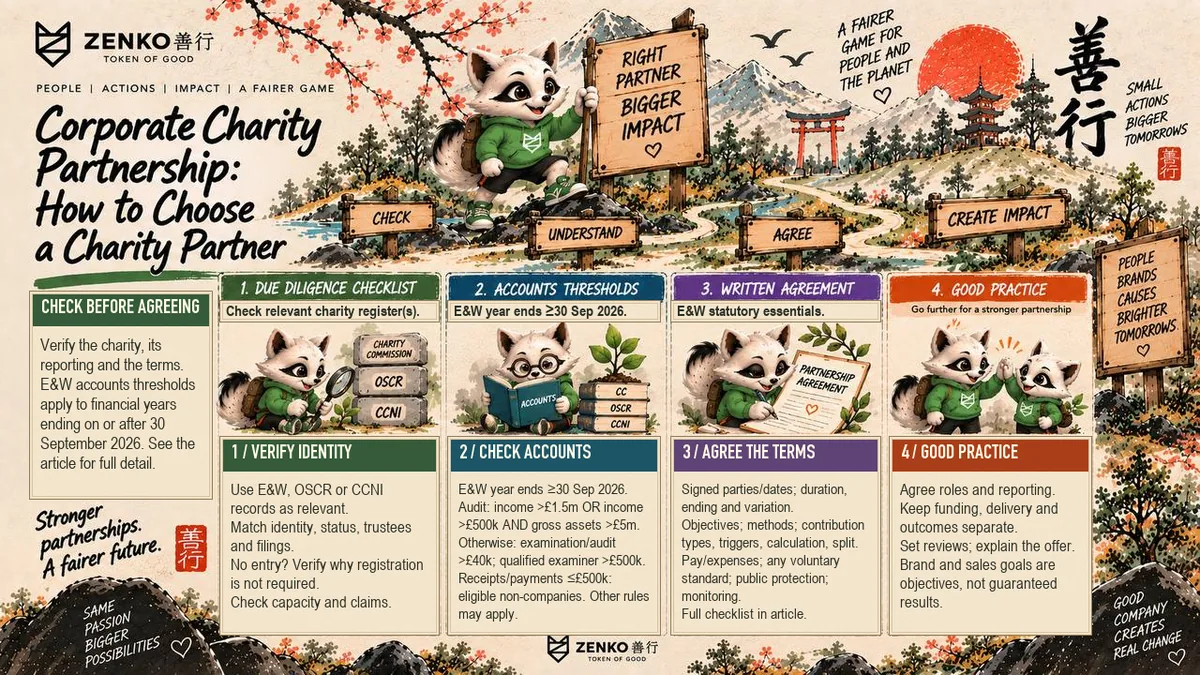
Choose a charity whose identity and work you can verify, whose cause your audience can understand, and whose team can agree clear terms and report what happens to the contribution. Consider fit, governance, delivery capacity and reputational risk together.
This guide gives a due diligence checklist for a corporate charity partnership, practical instructions for the UK registers, and the statutory essentials for an England and Wales commercial participation agreement. Other partnerships and jurisdictions need their own checks. It is part of our wider guide to cause marketing. Sources were checked on 11 October 2026. This is general information, not legal advice or approval of a proposed agreement or campaign.
What kind of partnership are you entering?
The checks depend on what the business and charity will actually do, not just what they call the relationship.
- A donation-linked promotion. In England and Wales, section 58 of the Charities Act 1992 covers a person carrying on a business for gain, other than a fundraising business, who runs a promotional venture representing that charitable contributions will benefit a charitable institution. Companies connected with the institution are excluded. If that test is met, a compliant signed agreement must be in place before making the qualifying representation under section 59. See Commercial Participators: The UK Rules for Charity-Linked Sales.
- A straightforward donation or sponsorship. A donation does not by itself make its donor a commercial participator. Merely mentioning a charity, sponsoring its event or describing charitable work does not automatically satisfy the statutory test. Assess the whole message and contribution arrangement: a representation can be express or implied. A charity may still require written terms, and advertising and fundraising standards can impose separate expectations.
- Employee fundraising or volunteering. These are distinct partnership activities, not automatically donation-linked sales promotions. Agree how staff will participate and how the charity's name and logo may be used.
A charitable institution is not necessarily a registered charity. Section 58 also includes institutions established for charitable, benevolent or philanthropic purposes. Promotions supporting general charitable purposes rather than a named institution can still carry statement obligations under regulation 7 of the 1994 Regulations, read with its 2009 amendment. Leaving a beneficiary unnamed is not a compliance workaround. Customer-action schemes and intermediaries need assessment against all the relevant definitions, not just the words “promotional venture”.
Scotland has a separate signed-agreement and information regime under the 2009 Regulations. Northern Ireland's equivalent agreement and statement provisions remain prospective. The Fundraising Regulator recommends following the England and Wales or Scotland requirements there as good practice. Advertising, consumer law and applicable fundraising standards still matter. Take advice for a cross-border partnership.
How much does fit matter?
Do not confuse a plausible brand story with a sound partnership. Fit can help people understand the relationship, but it does not replace checks on governance, delivery or reputation.
In a September 2025 American Marketing Association interview, the field-study researchers describe a preliminary, subjectively coded analysis that suggested small fit effects. They explicitly say that analysis was excluded from the published paper because interpretation was difficult. It is not evidence that brand-cause fit is unimportant, or that governance matters more in a measured sales model.
The original abstract of the 2023 meta-analysis reports 237 studies, a moderate average effect on attitudes (d = 0.458) and a smaller average effect on behavioural responses (d = 0.283), with high variation between studies. These are standardised effect sizes, not percentage sales lifts. Donation visibility was the strongest individual moderator of behavioural responses; priorities for attitudes and behaviour differed.
The original abstract of the separate 2024 field study reports 63 promotions across 20 fast-moving consumer goods categories, an average weekly sales lift of 4.9%, an average donation of 3.2% of product price and an average duration of 11 weeks. Those sample averages are not a forecast for your brand or a recommended donation rate. The later AMA interview also stresses wide variation in results. This summary is based on the verified original abstracts and the separately attributed public interview, not a full-paper review.
Choose a cause your customers and staff can understand and support, then test the proposed relationship against the practical checks below. Our guides on how people choose a cause and local vs global causes cover the audience side.
The due diligence checklist
| Check | Where to look | What you are looking for |
|---|---|---|
| Legal identity and charitable status | Relevant UK charity register guidance, OSCR and CCNI; legal-status documents where registration is not required | The legal entity, any registered name and number, contact details and authority of the person negotiating; a clear explanation and evidence if unregistered |
| Size and finances | Register entry and latest filed accounts | Income, spending and capacity proportionate to the proposed programme; timely reporting against the applicable jurisdiction, legal form and year-end requirements |
| Governance | Register record, governing document and annual report | Trustees or other responsible people, charitable purposes and decision-making authority that match the work you want to fund |
| Regulatory history | Register record and regulator notices | Inquiries, warnings, restrictions or removal; read the current record and ask for an explanation rather than assuming one label tells the whole story |
| The charity's own criteria | Charity-owned partnership pages and acceptance policies | Product or sector restrictions, decision process, information required and who can approve the relationship |
| Delivery evidence | Charity's annual or impact report and programme proposal | What the contribution will fund, how delivery is recorded and what evidence the charity can share; distinguish activity delivered from proven outcomes |
| Reputation | News, public records and previous partnership announcements | Relevant controversies, how earlier partnerships ended and each party's account |
| Conflicts | Your own supplier, customer and business relationships; the charity's policy | Conflicts with the charity's mission, your operations or the proposed claims |
The Fundraising Regulator's commercial-participator guidance explains due diligence, agreement and monitoring expectations from the charity's side. Read it to understand what a careful partner will ask you for. For payment thresholds, use the current legislation rather than the guidance's older £100 England and Wales passage.
How to use the three registers
England and Wales: Start at the government's charity register search. Search by name or number, then match the legal name, contact details, purposes, trustees and financial filings to the organisation you are dealing with. The official guidance explains that some small, excepted or exempt charities do not appear. A missing entry is not automatically fraud; ask for evidence of legal identity and charitable status.
Scotland: Use OSCR's register. Search by keywords or select “Search by Charity Number only” and enter the SC number. Open the record and check status, purposes, latest reporting and the accounts or trustee information available. The interface distinguishes active and former charities.
Northern Ireland: Use CCNI's charity search, not its general content search. Search by name or registration number, open the matching result, and check status and reporting information. Filters include status, income, regions worked, what the charity does and who it helps. Results can flag overdue returns or removal.
Check the registrations relevant to the organisation. Do not assume that operating in one nation means it has only one registration, or that every charity must appear in all three registers. Registration helps establish identity and regulatory status; it does not guarantee the proposed programme will work.
What charities themselves ask for
A partnership page is not necessarily a complete acceptance policy. These five charity-owned examples show what to prepare, not a guarantee that an approach will be accepted.
- Cancer Research UK: Its cause-led marketing information asks whether the product or service aligns with its cause and describes partnerships designed around company goals and cancer research. Prepare the product, intended audience and proposed contribution before approaching the team.
- British Heart Foundation: Its process is to contact the team, explain the business and objectives, and develop a tailored proposal. It describes product/cause alignment for cause marketing and alignment with its work for strategic CSR/ESG partnerships.
- Macmillan: Its guidance covers shared strategic goals, commercial opportunities, staff fundraising and volunteering. Prospective partners are asked for their name, contact details and company name. This page does not state a universal fundraising minimum or sector-exclusion list.
- Shelter: Its team describes partnerships that meet corporate responsibility objectives while helping tackle homelessness. Routes include commercial opportunities, employee fundraising, strategic partnerships and stock donations; the stock-donation offer includes reporting on income generated. Ask which route fits your proposal rather than assuming a donation buys logo rights.
- London's Air Ambulance Charity: Its acceptance policy expressly covers corporate partnerships. It checks funding sources, mission alignment, legal or reputational concerns, conflicts of interest and unacceptable financial liabilities. Alcohol, arms, tobacco and personal-injury-law sectors receive higher-level case-by-case consideration, not automatic exclusion under the published summary.
Accounts thresholds changed on 30 September 2026
England and Wales charity accounting thresholds changed under SI 2026/427. The new figures apply to financial years ending on or after 30 September 2026; earlier year ends retain the old thresholds. These are not UK-wide changes.
- Under section 144 of the Charities Act 2011, an audit is required where gross annual income exceeds £1.5 million, or where income exceeds £500,000 and year-end gross assets, before liabilities, exceed £5 million. The asset figure is not a separate income threshold.
- Where that audit requirement does not apply, section 145 requires independent examination or audit when income exceeds £40,000. Above £500,000, an independent examiner must have a listed professional qualification.
- The receipts-and-payments option under section 133 now extends to income not exceeding £500,000, but section 135 excludes charitable companies from that option.
- Group-account and group-audit income thresholds also rose to £1.5 million under the Order.
Other legislation, governing documents or funding conditions can require more scrutiny. Check jurisdiction, legal form and financial year before judging the accounts. Raised thresholds generally reduce the relevant statutory reporting burden; they do not mean more charities automatically need fuller accounts or a strategic report. Independently examined accounts rather than audited accounts are not, by themselves, a warning sign.
What the agreement must contain
For an England and Wales commercial participator, regulation 3 of the 1994 Regulations and section 59(7) and (8) set the statutory essentials. A written agreement signed by or on behalf of both parties must:
- identify the parties, their addresses and the dates of signing
- state its duration and any termination or variation terms
- describe its principal objectives and methods
- describe the types of contribution and the circumstances in which they arise
- explain how the charity's share or donation is calculated and, where several institutions are parties, how it is divided
- specify any remuneration or expenses payable to the commercial participator and how they are calculated
- specify any voluntary fundraising scheme or standard the business undertakes to follow
- specify how it will protect vulnerable people and the public from unreasonable intrusion on privacy, unreasonably persistent approaches and undue pressure to give money or other property
- set out arrangements enabling the charity to monitor compliance.
“Any voluntary standard undertaken” does not mean the statute requires adoption of one particular voluntary standard. The Fundraising Regulator's guidance says the agreement must be in place before the qualifying promotion starts and the charity must monitor compliance while it lasts. Its Code section 6 also has a written-agreement standard for third-party fundraisers, distinct from and wider than this statutory category.
The 1994 Regulations appear in original form on legislation.gov.uk. The official changes record lists amendments to regulations 1, 6 and 7; no change to regulation 3 was listed in the effects search checked on 11 October 2026. Read the additional section 59 requirements alongside it, rather than relying on an old template alone.
Good practice beyond the statutory checklist
The following are additional drafting suggestions, not a claim that every item is a separate statutory agreement requirement:
- the exact charity wording and branding the business may use, who approves it and how approval can be withdrawn
- payment dates, reconciliation records and proof of transfer, checked against any applicable legal payment duties
- what happens to money raised if the promotion stops early or the charity ceases to exist
- reporting: what each side will share, how often and in what format
- any proposed budget cap or guaranteed minimum, with the advertising mechanic and wording reviewed separately
- reputational exit terms and how press, social media and complaints will be handled.
A contract clause does not make an advertising claim lawful. CAP rules 8.33 and 8.34 require clear beneficiary, benefit and calculation information. Limits on the promoter's contribution must be disclosed, but rule 8.33.5 also says not to impose a cut-off for consumer contributions where an amount is stated for each purchase; money above a stated target should benefit the cause on the same basis. A disclosed cap is not automatic permission for an “every purchase” promise that stops funding the charity. Treat calculator caps as budgeting scenarios, not approved advertising wording.
A percentage of the customer price is different from a percentage of gross profit. CAP 8.34 expressly permits an actual amount or percentage of the price where part of that price is donated; the separate statutory notifiable-amount requirement must also be met. Fundraising Regulator guidance illustrates a profit-percentage promise with an expected minimum sum. Have the actual calculation, estimate, minimum and wording checked rather than treating a percentage alone as universally sufficient.
Have a qualified solicitor review the agreement and the proposed promotion. This checklist is not a substitute for that review or a statement that it has happened.
Red flags
These are practical warning signs drawn from the checks above, not documented case findings.
- The organisation cannot explain or evidence its legal identity and charitable status, or gives a registration number that does not match. Lack of a number alone is not proof of misconduct.
- It will not sign a compliant agreement where the relationship requires one. In England and Wales, making a qualifying commercial-participator representation without the prescribed agreement is unlawful under section 59; a casual charity mention alone is not that trigger.
- It cannot explain what the contribution will fund, or promises outcomes it cannot evidence.
- Required filings are overdue, or regulatory action has not been disclosed and explained.
- Exit terms leave you unable to respond sensibly if the partnership fails.
- A platform or agency handles the money without a clear account of deductions, transfers and what reaches the charity.
What we do not know
The sources reviewed for this guide do not establish a dependable average partnership lifespan or a causal reputational return. We make no claim about either. If another source gives a figure, check the population, method, timing and funder before treating it as a forecast. Research on consumer response is not a substitute for checking this charity's capacity to deliver this programme.
Next steps
Shortlist two or three organisations and verify each against the checklist. Then price the proposed contribution in the Cause Marketing Calculator so you know what the business can afford. Its output is a planning estimate, not legal approval of a cap, percentage or customer promise. Once the numbers and partner are right, settle the agreement and get the proposed claims reviewed before launch.
FAQs
How do I choose a charity partner for my business?
Choose an organisation whose legal identity, charitable status and work you can verify, whose cause your audience can understand, and whose team can agree clear terms and report on the contribution. Check governance, finances, regulatory history and delivery capacity alongside fit. Use the relevant registers and the charity's own partnership criteria; legitimate unregistered charities need appropriate status checks rather than automatic rejection.
Does brand and cause fit matter?
Fit can help explain the relationship, but it does not replace governance, delivery or reputation checks. In the AMA interview, the researchers describe a preliminary, subjectively coded fit analysis that was excluded from the published field study because interpretation was difficult. It does not establish that fit is unimportant or that governance has a larger measured sales effect.
How do I check that a charity is registered in the UK?
Search the relevant England and Wales, OSCR or CCNI register by name or number. Open the actual record and match identity, status, purposes and available financial and trustee information. An organisation may have more than one relevant registration. Some small, excepted or exempt England and Wales charities do not appear, so ask for evidence of their legal status instead of treating absence alone as fraud.
What should a charity partnership agreement include?
For an England and Wales commercial participator, the signed written agreement must identify the parties, addresses, signing dates, duration and termination or variation terms; describe objectives, methods, contribution types and triggers; explain the donation calculation and any split between institutions; and cover remuneration or expenses and their calculation. It must specify any voluntary fundraising standard undertaken, protections for vulnerable people and the public, and compliance-monitoring arrangements. See regulation 3 and section 59. Other partnerships and jurisdictions need their own checks.
Do I need a written agreement if I am only making a donation?
A straightforward donation does not by itself make the donor a commercial participator. The England and Wales test depends on the business, promotional venture and representation of charitable contributions in section 58. A written record can still be sensible, and the charity may require one. Get advice where a donation is used in a sales promotion, or a platform or intermediary is involved.
What are the warning signs of a bad charity partnership?
Warning signs include an unexplained or unsupported legal identity, a mismatched registration number, refusal to sign a required agreement, vague funding or delivery explanations, overdue required filings, unexplained regulatory action and opaque intermediary deductions. Missing registration alone is not enough: official guidance recognises charities that do not have to appear on the England and Wales register.
Sources
- Charities Act 1992, section 58: definitions and section 59: agreements.
- Charitable Institutions (Fund-Raising) Regulations 1994, regulation 3, regulation 7, official changes record and SI 2009/1060 amendments.
- SI 2026/427: thresholds and transitions; Charities Act 2011 section 133, section 135, section 144 and section 145.
- Scotland's 2009 Regulations; Northern Ireland 2008 Act section 150 and section 151, both prospective at the check date.
- Fundraising Regulator, commercial-participator guidance and Code section 6. Current statutory England and Wales payment thresholds supersede its older £100 passage.
- CAP Code, section 8, especially 8.33–8.34.
- Official register interfaces and guidance: England and Wales, Scotland and Northern Ireland.
- Charity-owned partnership guidance: Cancer Research UK, British Heart Foundation, Macmillan, Shelter and London's Air Ambulance Charity's acceptance policy.
- Schamp, Heitmann, Bijmolt and Katzenstein (2023), The Effectiveness of Cause-Related Marketing: A Meta-Analysis on Consumer Responses, Journal of Marketing Research 60(1), 189–215. Original abstract; DOI. Full paper not reviewed for this guide.
- Schamp, Heitmann, Peers and Leeflang (2024), field study of cause-related promotions, Journal of Marketing Research, 955–974. Original abstract; DOI. Full paper not reviewed for this guide.
- American Marketing Association (25 September 2025), Do Good, Sell More, public interview; its preliminary fit discussion was excluded from the published field-study paper.
This article is general information, not legal advice. Obtain qualified review of the actual partnership, agreement and promotion before launch.