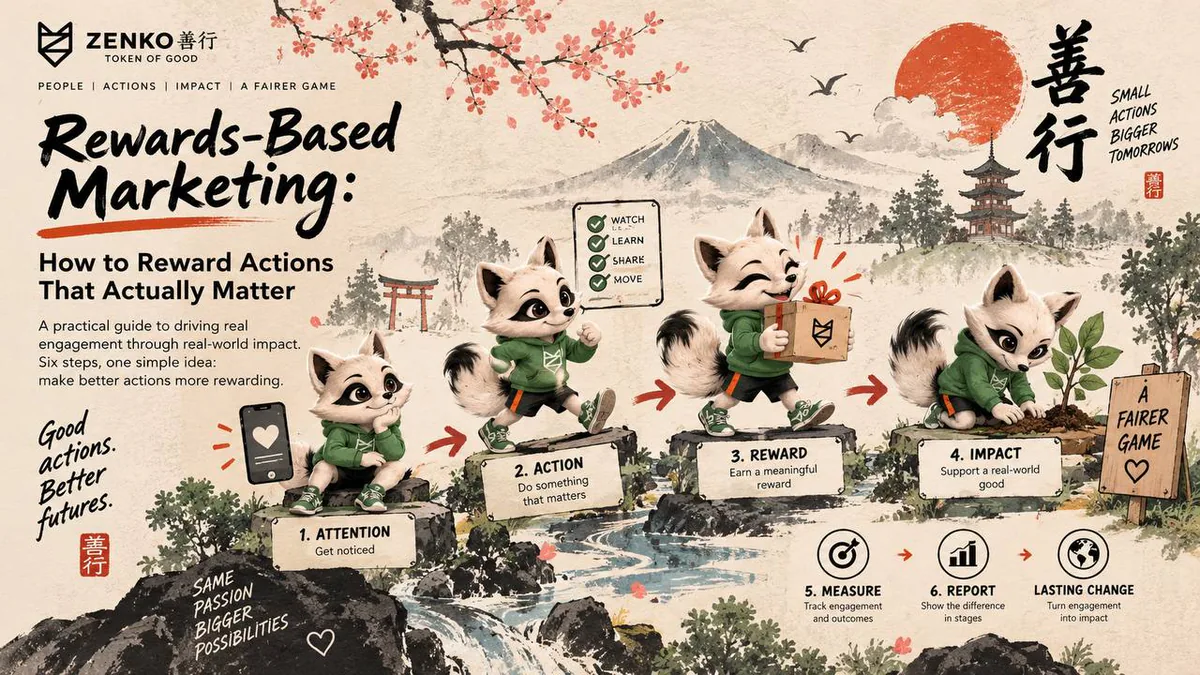
Editorial illustration, not a live product screen or a promise of results. Open the full-size illustration.
Rewards-based marketing is the practice of giving a customer a proportionate reward for one specific, useful, verifiable action, then measuring what they do once the reward has gone. The reward can be a benefit, access, recognition or a contribution to a cause. It does not have to be a discount and it does not need a token. What separates it from a coupon is the order of work: choose the behaviour, price the reward, verify the action, then judge the campaign on what happens next.
Most guides to incentive marketing stop at a list of reward types. That is the easy part. The hard part is that rewards buy a first action far more reliably than they buy a habit. In a US field study of 61,293 gym members, 54 four-week programmes were tested. While they ran, 45% raised weekly visits by 9% to 27%, and only 8% still showed a measurable effect after they ended (Milkman et al., Nature, 2021). A cheap engagement is not automatically a good one, and a campaign that only counts the first action will keep paying for behaviour it never changed.
This guide sets out a six-step method, the evidence behind each step, a hypothetical worked example and a launch checklist. You can run all of it without buying anything from us. Where Zenko fits is covered after the checklist.
What rewards-based marketing is, and what it is not
| Compared with | The difference |
|---|---|
| A points-for-purchase loyalty programme | A loyalty scheme rewards spend over time. Rewards-based marketing rewards a chosen action because of what it predicts, such as finishing a product course, attending a session or returning after a lapse. The two can run side by side. |
| A sales promotion | A promotion is judged on the volume bump. A rewards-based campaign is judged on behaviour after the reward and on lift against a comparison group. |
| Paying for clicks or leads | A paid lead is an attributed event. A rewarded action is verified first, then priced against what it is worth downstream. |
| A token scheme | A token is one possible reward and is never required. Access, recognition, a benefit or a donation can do the same job. |
Step 1: Start with the outcome and the next behaviour
Answer three questions before you choose a reward.
- What outcome do you need? A qualified enquiry, a repeat purchase, a finished course or a returning customer.
- What would this customer do without an incentive?
- What would prove that customer quality has improved?
The second question decides where your money goes. Charness and Gneezy paid people to attend a gym for a month. Attendance stayed higher afterwards, but the gain came entirely from people who had not attended regularly before (Econometrica, 2009). Reward your regulars for something they already do and you have bought behaviour you would have had for free. Aim the reward at people who are not yet doing the thing, and write down what "better" looks like before launch.
Step 2: Pick one observable action
Choose a single action that a system, not the customer, can confirm. Score each candidate from 1 to 5 on seven criteria: value to the customer, value to the brand, verifiability, frequency, privacy cost, fraud risk and whether you can still see behaviour after the reward ends. Reject any action that scores 1 on verifiability or on the post-reward signal. The full matrix, with a scored example, is in How to Choose the Right Customer Action to Reward. For background on why some actions can be checked and others cannot, see our guide to verified real-world actions.
Here is a hypothetical journey. It is an illustration, not a Zenko campaign result.
A UK software company wants more qualified demo requests.
- Action: a prospect completes a 20-minute product module and passes a five-question check.
- Verification: the learning platform records completion and score. There is one reward per verified person, and a sample is checked by hand for duplicate identities.
- Reward: an access reward, such as an extended trial or a place in an expert session, plus a contribution to a cause chosen from a short list.
- Follow-through: completers are offered a demo. A random 10% of the audience is held out and not invited, so lift can be measured.
- Outcome check: demo requests, sales-qualified conversations and repeat module use at 60 and 120 days, with no reward running in the second window.
Step 3: Match the reward to the effort
- Keep it proportionate. A reward that dwarfs the task attracts completion without care.
- Reward the return, not only the streak. In the gym study, one of the strongest designs paid a small bonus for coming back after a missed workout. Lapses are where behaviour is lost, so they are where a small reward has the most to do. There are more documented examples, with their limits.
- Mind the framing. A review of incentive studies by Gneezy, Meier and Rey-Biel found that incentives can shift how people see a task from social to monetary, which can weaken intrinsic motivation even when the incentive works in the short term (Journal of Economic Perspectives, 2011).
- Fix the rules before launch. Set eligibility, caps, closing date, fulfilment and disclosure. UK promotional rules under the CAP Code expect significant conditions to be made clear to the customer.
- Treat a reward for good as a design option, not a proven advantage. We know of no peer-reviewed evidence showing that cause-linked rewards beat cash or access at changing behaviour, so we do not claim it. Test it against another reward with a holdout group.
- Never reward sentiment. Pay for the action, not for what someone says about you.
Step 4: Verify the action before you reward it
- Prefer system records to self-report. A completion log, a purchase record or activity data beats a customer saying they did it.
- Expect farming where rewards are cheap and repeatable. LayerZero reported 803,093 potential sybil addresses in its 2024 airdrop (LayerZero, May 2024). That is a crypto example and a company report, but the pattern applies to any reward that is cheap to claim many times. Our guide on how to prevent reward farming without punishing real customers covers the controls and their privacy cost.
- Build a fallback and an appeal. Every filter catches some real people, so give them a human route to challenge a decision.
- Collect the minimum data. Taking part in an incentivised action is not consent to unrelated marketing (ICO guidance on valid consent).
- Do not confuse a record with an outcome. A database or on-chain entry proves a record was written. It does not prove a meal was eaten or a tree survived. Physical outcomes need evidence from the delivery partner.
Step 5: Measure what happens after the reward
Measure in this order:
- Participation rate
- Verified qualified-action rate
- Cost per verified qualified action
- Downstream conversion
- Repeat action after the reward ends
- Incremental lift against a comparison group
Put every cost in the numerator:
Cost per verified qualified action = (media and acquisition spend + rewards + fulfilment + platform fees + review time + other operating costs + fraud losses) divided by verified qualified actions
This is a different number from cost per lead, which counts an attributed event of any quality.
The comparison group matters because attributed results flatter campaigns. Gordon and colleagues compared observational methods with randomised experiments across 15 Facebook advertising campaigns and found that the observational methods often failed to reproduce the experimental results, and tended to overstate effectiveness (Marketing Science, 2019). Those were ad campaigns rather than reward campaigns, but the logic carries over, because people who take up an offer differ from people who do not. A simple before-and-after comparison cannot separate the reward's effect from seasonality, other marketing or self-selection. Formulas, a numbered example and the pitfalls are in How to Measure a Rewards-Based Campaign.
Step 6: Report impact in stages
If the reward includes a contribution to a cause, report four stages separately and do not let one stand in for another.
- Action completed. Evidence: platform records.
- Funds allocated. Evidence: finance records, with dates.
- Partner delivery. Evidence: the delivery partner's records.
- Independently verified outcome. If it has not been independently verified, say so.
State your unit. The FareShare-linked meal-equivalent methodology uses 420g of food as one meal equivalent, following WRAP guidance. Greggs reported 420 tonnes of food redistributed through FareShare and described it as the equivalent of more than one million meals (Greggs), which works out at 420g a meal. So "meals' worth of food" describes a weight. It does not describe plates eaten.
Here is a documented example. MK Dons launched its Buy a Home Shirt, Feed a Child programme with Zenko in June 2025. Each shirt sold was linked to a meal's worth of food for projects feeding children in food poverty in Milton Keynes (Milton Keynes Citizen). The reported delivery is 2,000 meals' worth of fresh produce through four local hubs, set out in Zenko's case study of the MK Dons programme. That is a delivery result. It does not show the campaign raised shirt sales, and we do not present it as one.
Keep environmental claims specific and evidenced. EU Member States must apply national measures implementing Directive (EU) 2024/825 from 27 September 2026. For EU consumer marketing, the rules prohibit generic environmental claims unless the trader can demonstrate recognised excellent environmental performance relevant to the claim. They separately prohibit claims, based on greenhouse-gas offsetting, that a product has a neutral, reduced or positive greenhouse-gas impact. This is not a blanket ban on every specific environmental claim or a statement of UK-only law. Take advice on the rules applying to your market and wording.
Launch checklist
- The outcome and the baseline are written down.
- One action is chosen, and a system can verify it.
- A random holdout group is defined.
- The reward is sized to the effort, and caps, dates and fulfilment are set.
- Eligibility and significant conditions are published.
- Verification, review and appeal routes exist.
- Data collection is minimal and consent is kept separate.
- Every cost is tracked, including fraud losses.
- The impact stages and the meal or unit convention are agreed.
- Post-reward checks are dated, for example day 60 and day 120.
- The stop rule is fixed before launch: the smallest lift that would count as a result.
- One named person signs off.
Where Zenko fits
Everything above is a method you can run without us. Zenko connects brand-funded participation with rewards and contributions to causes. Its MK Dons case study documents a purchase-linked food programme, not a guarantee that every proposed mechanic or integration is available.
For a new campaign, scope the action, verification method, payout rules, review route and comparison group before launch. Learning, movement, shopping and play are possible action families to discuss; suitability and availability depend on the programme. Where a campaign includes a reward for good, agree the funding and delivery evidence and report the four stages separately.
Cost per lead is where the conversation starts, though, and a cheap lead that never buys is still expensive. Report cost per verified qualified action next to it, and check what those leads do afterwards.
If you work in performance or growth, start with our page for marketers. If you are planning a brand or sponsorship programme, see for brands.
Tell us the action you want to reward and the outcome you need. We will show you how a campaign could work.
Plan a rewards-based campaign with Zenko
Frequently asked questions
What is rewards-based marketing?
Rewards-based marketing is giving customers a proportionate reward for a specific, useful, verifiable action, then measuring what they do after the reward. The reward can be a benefit, access, recognition or a contribution to a cause, and no token is needed.
How is rewards-based marketing different from a loyalty programme?
A loyalty programme rewards repeat spend over time. Rewards-based marketing rewards a chosen action, such as completing a course or returning after a lapse, because that action predicts the outcome you want. The test is what customers do once the reward stops, and the two approaches can run together.
What should brands reward?
Reward an observable action that predicts value and that people who were not already doing it will take up. Completing a course, staying to the end of a session, returning after a lapse and a qualified referral all fit. Likes and clicks are easy to count and easy to fake, so they rarely fit.
How do you measure a reward campaign?
Track participation, verified qualified actions, cost per verified qualified action, downstream conversion and repeat action after the reward ends. Include every cost, and compare against a randomised holdout group, because attributed results tend to overstate what a campaign achieved.
Can incentives attract low-quality participants?
Yes. It happens when rewards are transferable, the action is cheap to fake and eligibility is open. The fix is in the design: verify before you pay, cap and delay payouts, collect minimal data and give real customers a route to appeal.
Sources
- Milkman et al., Megastudies improve the impact of applied behavioural science, Nature, 2021
- Charness and Gneezy, Incentives to Exercise, Econometrica, 2009
- Gneezy, Meier and Rey-Biel, When and Why Incentives (Don't) Work to Modify Behavior, Journal of Economic Perspectives, 2011
- Gordon et al., A Comparison of Approaches to Advertising Measurement, Marketing Science, 2019
- LayerZero, sybil self-report update, May 2024 (company-reported)
- ICO, what is valid consent
- FareShare meal convention
- Greggs and FareShare (company-reported)
- Milton Keynes Citizen, MK Dons shirt programme
- Official text of Directive (EU) 2024/825
In this rewards-based marketing series
- How to Choose the Right Customer Action to Reward
- How to Measure a Rewards-Based Campaign
- How to Prevent Reward Farming Without Punishing Real Customers
- Incentive Marketing Examples That Work Beyond Discounts
Related acquisition measurement
For channel comparisons after acquisition, use the Pipeline Maturity Curve to compare leads at the same age before moving budget.