Purpose Marketing vs Cause Marketing vs CSR vs Sponsorship
Working definitions of purpose marketing, cause marketing, CSR and sponsorship, with practical distinctions and the separate UK legal tests.
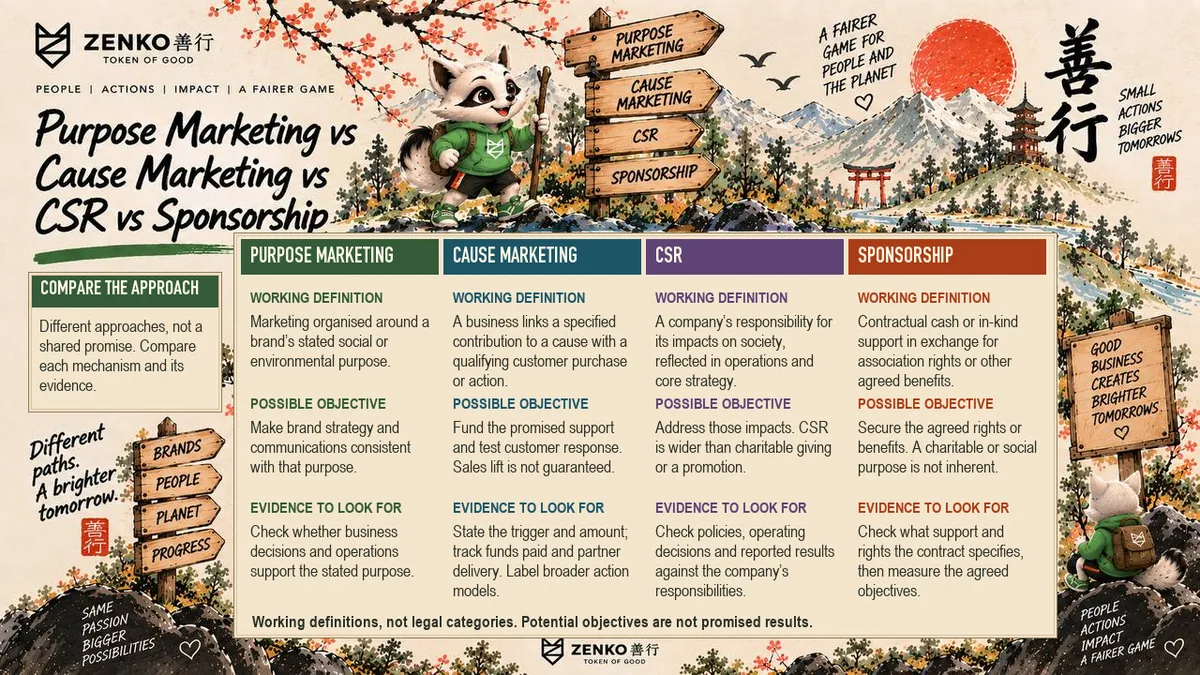
The four terms describe different things. Purpose marketing organises marketing around a brand's stated social or environmental purpose. Cause marketing links a purchase or other customer action to support for a cause. Corporate social responsibility (CSR) concerns a company's responsibility for its impacts on society. Sponsorship exchanges support for association rights or other agreed benefits; that support need not be cash.
They overlap in a marketing plan, but differ in what triggers expenditure, what evidence matters and which rules may apply. This guide gives working definitions, a comparison table and practical questions. It sits alongside our main guide to cause marketing.
These are working marketing definitions, not separate legal categories. For CSR, we follow the European Commission's focus on responsibility for impacts on society, section 3.1. For sponsorship, we follow the International Chamber of Commerce's contractual exchange of support for association rights or other agreed benefits, chapter B, pages 42–43. Purpose marketing is a practical description here, not a formally standardised legal term. CIM's discussion of purpose and established brand values supplies practice context, not an official definition or proof of commercial benefits.
Cause marketing, first
Varadarajan and Menon's 1988 Journal of Marketing paper is a foundational academic account. Its transaction-linked conception centres on a business offering a specified contribution to a designated cause when customers buy. This is a paraphrase: the original definition page was not independently read, so no verbatim quotation or pinpoint page is claimed. This guide also discusses related customer-action promotions, keeping unconditional corporate giving and employee volunteering distinct.
The England and Wales commercial-participator test is a different question, not a legal definition of cause marketing. Section 58 of the Charities Act 1992 covers a person carrying on a business for gain, other than a fundraising business, who runs a promotional venture representing that charitable contributions will benefit a charitable institution. Companies connected with the institution are excluded. Merely mentioning a charity, sponsoring its event or describing charitable work is not automatically sufficient. The actual contribution arrangement and full express or implied message matter, not the marketing label. Non-purchase action and platform models need case-specific assessment rather than an automatic covered/exempt verdict.
Working definitions
Purpose marketing. Marketing organised around the brand's stated social or environmental purpose. It need not involve a donation. Its evidential test is whether the company's conduct supports the claims, not whether the purpose sounds appealing. Purpose marketing does not itself prove better loyalty or commercial performance.
Cause marketing. A promotion connecting a customer's purchase or action to promised support for a named cause, usually a donation or delivered help. In the narrower academic conception, the contribution is tied to a revenue-producing transaction. Check the contribution arithmetic, evidence that the promise was fulfilled, and any separate claim of additional sales or social benefit.
Corporate social responsibility. A company's responsibility for its impacts on society, reflected in its operations and core strategy as well as its reporting. It is wider than charitable giving or promotion. The European Commission's section 3.1 also describes integrating social, environmental, ethical, human-rights and consumer concerns into operations and core strategy in collaboration with stakeholders. CSR is not simply a report or an advertising campaign.
Sponsorship. A contractual arrangement in which a sponsor provides money or other support in exchange for association rights or other agreed benefits. It may concern an event, organisation, activity, individual, media property or location. Cash is not essential: in-kind support can qualify. This follows the ICC's sponsorship definition and scope. Sponsorship need not have a charitable or social purpose; assess the agreed rights, delivery and objectives rather than treating exposure or sales as guaranteed.
How they compare
This is a planning comparison, not a ranking of proven benefits or a substitute for legal assessment.
| Purpose marketing | Cause marketing | CSR | Sponsorship | |
|---|---|---|---|---|
| What it is | Marketing around stated purpose | A promotion linked to promised cause support | Responsibility for company impacts on society | Contractual exchange of support for association rights or benefits |
| What triggers expenditure | Brand and business decisions | Defined purchase/action or other agreed campaign mechanism | Operational and strategic decisions | Agreed cash or in-kind support |
| Intended beneficiaries or objectives | Intended brand meaning and relevant social/environmental aims; not assured loyalty | Promised support for the cause; commercial return must be tested | People and other stakeholders affected by the business | Supported party and sponsor's agreed objectives; no necessary charitable purpose |
| Evidence needed | Conduct supporting claims | Contribution/delivery records; credible evaluation for sales-effect claims | Operational evidence, reporting and appropriate assurance | Contracted rights, delivery and outcome measures appropriate to objectives |
| Main risk | Unsupported purpose claims | Unaffordable contribution or misleading claims | Selective reporting or unsupported claims | Undelivered rights, poor association or reputational concerns |
| Potentially relevant UK rules | Advertising and consumer law; sector rules | Applicable commercial-participator regime, CAP 8.33–8.34 and general law | Applicable operational/reporting duties and claims rules | Advertising and consumer law; charity-linked rules if the actual arrangement/message falls within scope |
Which UK rules apply?
The label is not decisive, but neither is a charity's name appearing in copy. Check the business, contribution arrangement and representation against the applicable regime.
For England and Wales commercial participators, a compliant signed written agreement must be in place before the qualifying representation, and section 60 requires beneficiary identification, any applicable split and the actual or carefully estimated notifiable charitable amount. The amount is not the business's own remuneration. A charitable institution is not necessarily registered: section 58 also includes institutions established for charitable, benevolent or philanthropic purposes. Promotions for general charitable purposes can carry statement obligations under regulation 7, as amended in 2009. Leaving the beneficiary unnamed is not a compliance workaround.
Scotland has its own 2009 Regulations, including signed agreements and distinct oral/written information rules. Northern Ireland's corresponding sections 150 and 151 remain prospective as checked on 11 October 2026. The Fundraising Regulator recommends following England/Wales or Scotland requirements there as good practice. Its wider agreement standards are distinct from the statutory test. See Commercial Participators: The UK Rules for Charity-Linked Sales.
CAP 8.33 and 8.34 separately require charity-linked promotions to name each beneficiary and support the relationship with a formal agreement. They require the beneficiary's nature and objectives where it is not a registered charity, the benefit and calculation basis, and relevant contribution limits. Where part of the price is donated, state the actual amount or percentage of price; other charity-linked promotions must state the total or a reasonable estimate. Rule 8.33.5 also prohibits a consumer-contribution cut-off where an amount is stated for each purchase. Simply disclosing a cap does not approve a capped every-purchase claim. Formal advertising and fundraising-standard requirements can apply beyond a shorthand description of statutory commercial participation.
A sponsorship message promising a share of ticket income to a hospice is a charity-linked claim that needs the relevant checks, even if the underlying contract is called sponsorship. A purpose statement about reducing food waste does not, by itself, establish the statutory commercial-participator test. Its truth and evidence still matter.
The final CMA207 guidance, first published 4 April 2025 and updated 18 November 2025, explains the DMCC Act unfair-commercial-practices provisions applying from 6 April 2025. They replaced and updated the Consumer Protection from Unfair Trading Regulations 2008. The guidance covers misleading actions and omissions, aggressive practices and 32 practices banned in all circumstances. For misleading actions and omissions, the statutory conditions include likely effect on the average consumer's transactional decision. False or materially incomplete purpose or charity claims can breach these rules; this is not CMA approval of a contribution model. See also carbon offsetting and greenwashing.
Examples of the difference
These are hypothetical illustrations, not approved advertising templates or evidence of financial results.
- A bakery builds its marketing around reducing food waste and responsible employment. That is purpose marketing; concrete statements about ingredients or wages need evidence.
- The bakery proposes a December promotion contributing 20p per loaf to a named local food bank. That is transaction-linked cause marketing. Check the statutory test, required signed agreement, CAP's formal agreement and full claim information before launch.
- The bakery integrates energy, packaging and supplier responsibilities into operations and reports what it has done. That is CSR activity; publishing the report is not the whole responsibility.
- The bakery supplies refreshments in exchange for named-supporter rights at a local arts festival. That is in-kind sponsorship. No cash payment or charitable purpose is necessary for that working classification.
Real campaigns overlap. A purpose-led brand can run a cause promotion. A sponsorship can include a donation. Apply the rules to each actual arrangement and claim rather than relying on the chosen label.
Which one fits?
Ask these questions in order.
- What are you trying to change? Brand perception and immediate customer action are different objectives. State the objective and time horizon rather than assuming any category guarantees a result.
- Can you afford the promise? Use the Cause Marketing Calculator to model baseline sales, gross contribution, donation and other campaign costs. Its cap scenarios and generated wording are planning aids, not legal approval or net-profit forecasts. If the case rests on reputation rather than measurable incremental contribution, budget it accordingly.
- Can you show the right evidence? Cause claims need contribution and delivery records. Purpose claims need supporting conduct. CSR needs operational evidence. Sponsorship needs delivery against the agreed rights and objectives. None automatically establishes sales lift.
- Does the arrangement meet the statutory commercial-participator test, and which advertising rules apply? A charity mention alone is not the trigger. If the statutory test is met, put the compliant signed agreement in place before the qualifying representation. Check CAP's formal-agreement and disclosure requirements separately.
- What uncertainty can you accept? Narrow, evidenced claims are easier to check than broad promises. Partner identity, delivery capacity and reputational risk matter alongside audience fit.
Brands considering programme-specific verified actions can read why people support causes and For Brands. Verification of an action alone does not prove a charitable outcome; agree the funder, contribution, eligibility and delivery evidence.
FAQs
What is purpose marketing?
Here, purpose marketing means marketing organised around a brand's stated social or environmental purpose. It need not involve donations. This is a working description, not a standardised legal category. The company's conduct must support its claims; CIM's purpose discussion emphasises alignment with established values.
What is the difference between purpose marketing and cause marketing?
Purpose marketing organises marketing around the brand's stated purpose. Cause marketing links participation, usually a purchase, to promised support for a cause. The narrower academic conception is transaction-linked. A brand can express purpose without a donation campaign, or run a cause promotion without a brand-wide purpose position.
Is CSR the same as cause marketing?
No. Following the European Commission's definition, CSR is a company's responsibility for its impacts on society, reflected in operations and core strategy as well as reporting. Cause marketing is a promotion linking participation to promised support. Charitable promotion is not the whole of CSR.
Is sponsorship a type of cause marketing?
Not by itself. The ICC definition describes contractual support in exchange for association rights or other agreed benefits; in-kind support can qualify and a charitable purpose is not necessary. If a sponsorship includes a charity-linked promotional claim, assess that claim and arrangement under the applicable charity, advertising and consumer rules. A charity mention alone does not establish statutory commercial participation.
Which of these has specific UK rules?
Charity-linked promotions have specific advertising requirements under CAP 8.33–8.34. England and Wales promotions satisfying the section 58 commercial-participator test need the prescribed signed agreement before the qualifying representation and the required statement information. Scotland has its own regime; Northern Ireland's equivalent provisions remain prospective. Formal-agreement standards may also apply outside the statutory test. General advertising and consumer law applies according to scope across all four activities.
Which one should a small business choose?
Start with the objective, budget and evidence you can produce. A cause promotion can be modelled for break-even, but payback must be tested. Purpose claims need consistent conduct. CSR concerns responsibilities in the business itself. Sponsorship fits where agreed rights and benefits serve a clear objective; exposure or sales are not guaranteed.
Sources
Checked 11 October 2026. Working definitions are not legal classifications; no solicitor review is claimed.
- Varadarajan and Menon (1988), Journal of Marketing 52(3), 58–74. Bibliography/DOI verified; original definition page not independently read: https://doi.org/10.1177/002224298805200306
- European Commission, COM(2011)681, 25 October 2011, section 3.1: https://eur-lex.europa.eu/legal-content/EN/TXT/?uri=CELEX:52011DC0681
- ICC Advertising and Marketing Communications Code, September 2024, chapter B, pages 42–43: https://iccwbo.org/wp-content/uploads/sites/3/2024/09/ICC_2024_MarketingCode_2024.pdf
- CIM, November 2025 practice context, not a formal definition: https://www.cim.co.uk/content-insights/articles/webinar-recap-black-friday-guide-to-short-vs-long-term-benefits/
- Charities Act 1992, sections 58–60: https://www.legislation.gov.uk/ukpga/1992/41/section/58 ; https://www.legislation.gov.uk/ukpga/1992/41/section/59 ; https://www.legislation.gov.uk/ukpga/1992/41/section/60
- 1994 Regulations, regulations 3 and 7: https://www.legislation.gov.uk/uksi/1994/3024/regulation/3/made ; https://www.legislation.gov.uk/uksi/1994/3024/regulation/7/made ; 2009 amendment: https://www.legislation.gov.uk/uksi/2009/1060/made
- Scotland 2009 Regulations: https://www.legislation.gov.uk/ssi/2009/121/made
- Northern Ireland prospective provisions: https://www.legislation.gov.uk/nia/2008/12/section/150 ; https://www.legislation.gov.uk/nia/2008/12/section/151
- Fundraising Regulator, Code section 6: https://www.fundraisingregulator.org.uk/code/standards-which-apply-working-others/fundraising-partnerships
- CAP Code, section 8: https://www.asa.org.uk/type/non_broadcast/code_section/08.html ; charity-linked promotions guidance, 4 February 2026: https://www.asa.org.uk/advice-online/promotional-marketing-charity-linked-promotions.html
- CMA, final Unfair commercial practices (CMA207), first published 4 April 2025, updated 18 November 2025: https://www.gov.uk/government/publications/unfair-commercial-practices-cma207/unfair-commercial-practices
This article is general information, not legal advice. Obtain advice on the actual arrangement and wording before launch.