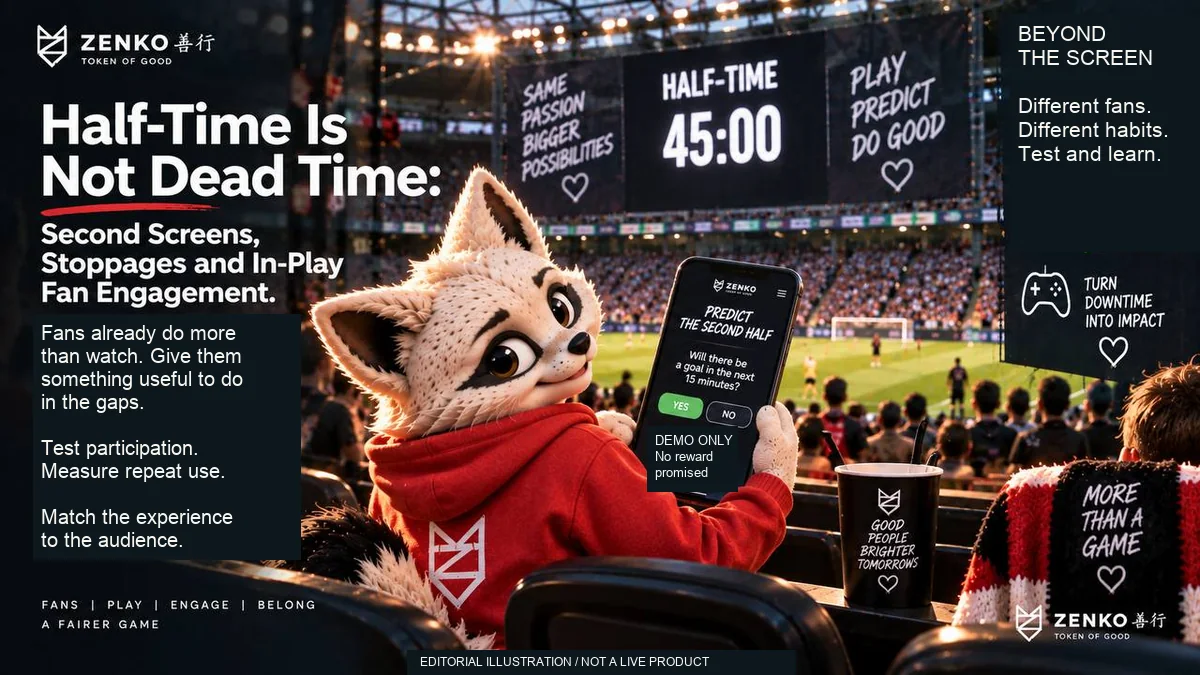
Editorial illustration, not a live product screen or measured performance chart.
Some of sport's most under-used participation opportunities sit inside the match. Half-time, VAR reviews, injury stoppages, the ten minutes before kick-off: phones are already out, but the club may have nothing useful on them. This is the matchday layer of the fan engagement calendar. The audience is present; earning its attention is still a job.
The second screen is already part of watching
Deloitte's 2023 US Sports Fan Insights research describes fans doing other game-related activities while watching at home. That includes looking up information, social activity and other behaviours. It is not the same measure as the share using a second device, and it should not be relabelled as one.
Then look at who watches all the way through. Altman Solon's 2025 Global Sports Survey, fielded in December 2025 across six countries, found that 39 per cent of 18 to 24 year olds typically watch an entire event, compared with 61 per cent of fans aged 65 and over. That is an age-group survey comparison across sport, not a measurement of every football match.
This is not an attention span problem
The lazy conclusion is that young fans cannot concentrate. These surveys do not establish that. I would not build a strategy on a sweeping attention-span claim when the practical question is simpler: what would make the gap worth the fan's time?
Deloitte also found higher levels of several attendance and spending behaviours among sports bettors than non-bettors. That is an association, not proof that wagering caused the difference, and it cannot be transferred automatically to free-to-play prediction games. The useful hypothesis is that some already committed fans want an active way to follow the match. Test that without turning the game into a betting pitch.
So the dead minutes are not dead. They are unclaimed.
What the free-to-play category can tell us
Free-to-play prediction is one candidate for in-match gaps. Public vendor results can inform a pilot, provided the club does not mistake them for a forecast.
MoZeus reports 80 per cent-plus data opt-in and 8 to 12 minutes of dwell time for FanPlay. Those are its own reported results, not independent category benchmarks. Define your own return-rate measure before testing. A prediction can create a useful first-party signal only when the data arrangements are properly designed; The Invisible Fan explains the distinction.
The proposed experience can have no cash stake. That alone does not settle its legal classification, eligible audience or promotion rules. Mechanics, prizes, entry routes and jurisdiction need review by qualified advisers before launch. This article makes no blanket claim that free-to-play needs no licence.
A framework for the in-match calendar
Map the match the way you map the season. Each trough gets a mechanic.
| Moment | The trough | The mechanic |
|---|---|---|
| 48 hours out | Anticipation with nothing to do | Line-up prediction, squad picks |
| Pre-kick-off | Waiting | First-scorer and result predictions close at the whistle |
| Half-time | Fifteen minutes of nothing | Second-half predictions, squad leaderboard |
| VAR and stoppages | Frustration | Micro-predictions on the next event |
| Full time | The ending | Results, squad position, what supporters directed together |
Three rules. Keep the proposed experience free of cash stakes. Agree age eligibility, prize rules and safeguarding with the product and legal owners, rather than treating an 18-plus gate as a universal solution. Then connect full time to the post-match message, because the point is to own the ending.
Where Zenko fits
Predictfully is named in Zenko's published partnership history. That supports describing a relationship, not promising a current combined product. A proposed matchday programme could combine predictions, squads and an agreed sponsor-funded pool. Availability, integration, allocation rules and the wording of any outcome message still need confirmation with the teams involved.
The aim is simple: give fans something useful to do in the dead minutes, then show them what happened. Measure whether they return. Do not promise the club its best-attended session before the pilot has run.
FAQ
What percentage of sports fans use a second screen? Estimates vary with the audience and definition. Deloitte's 2023 US research describes game-related multitasking at home, but that is not an exact second-device rate. Use a source that measures the behaviour you actually mean.
What is a free-to-play prediction game? It asks fans to forecast an outcome without a cash stake in the proposed experience. Points, prizes, eligibility and promotional terms vary. Free entry is not by itself a legal conclusion; the exact design needs jurisdiction-specific review.
Do young fans watch whole matches? Fewer than older fans. Altman Solon's 2025 research found only 39 per cent of 18 to 24 year olds typically watch an entire event, against 61 per cent of fans aged 65 and over.
Does gamification increase fan engagement? It can be tested as a way to encourage participation. Vendor reports are useful hypotheses, not causal proof or guaranteed results. Compare opt-in, repeat participation and fan satisfaction against a defined baseline, using approved data practices.
Start with your calendar
Request a fan engagement calendar audit. Bring the fixture list and the gap you want to fix.