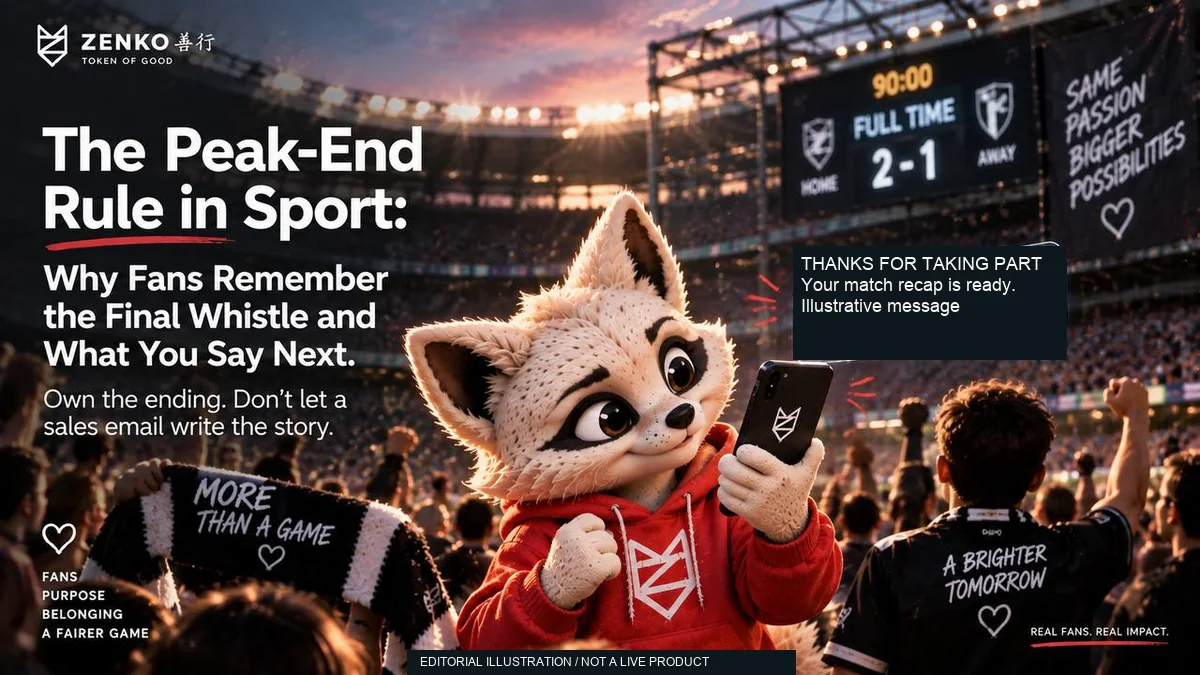
Editorial illustration, not a live product screen or measured performance chart.
A final whistle is not the last thing a fan experiences. There is the walk home, the phone check and whatever the club sends next. The peak-end rule suggests that intense moments and endings can weigh heavily in memory. It does not prove that fans forget the rest of a match. This piece is about taking the follow-up seriously, as part of the fan engagement calendar.
The science, briefly
In 1993 Daniel Kahneman, Barbara Fredrickson, Charles Schreiber and Donald Redelmeier published When More Pain Is Preferred to Less: Adding a Better End. Participants experienced 60 seconds with a hand in cold water and a longer trial with an extra 30 seconds of slightly warmer water. Many preferred to repeat the longer trial. The better ending could outweigh the added duration in their retrospective choice. This was an experiment about discomfort, not a test of football fan retention.
Kahneman later described the gap between the experiencing self and the remembering self. A memory is not a complete recording. Peaks and endings can carry more weight than duration. That gives a club a useful question: what experience are we leaving the fan with? It does not give the club permission to neglect everything in the middle.
Chip and Dan Heath's The Power of Moments (2017) turns memorable moments into a design question: what creates insight, pride and connection? Their Magic Castle Hotel example is a useful image to borrow. An ordinary hotel puts a red phone by the pool; pick it up and a staff member brings a free ice lolly. The memorable detail is small and deliberate. A club does not need a bigger production budget to think that way.
Sport's shape: a brilliant peak, an abandoned ending
Sport already has the ingredients for a peak: ninety minutes, a crowd, a last-minute winner. The part a club can more directly design is its own response after the whistle.
After defeat, some fans distance themselves from the team. The fan psychology literature calls this CORFing, cutting off reflected failure, and distinguishes it from basking in reflected glory after a win. Identification matters: it is not a rule that every supporter withdraws. Write for disappointment without assuming the relationship has vanished.
Now look at what the club sends next. If the ticketing system fires off a subject line about Tuesday, the supporter is being asked for money before they have got home. We cannot say that email becomes the fan's entire memory. We can say it is a moment the club could handle better.
That is not a strategy. It is a reflex.
Own the end: a three-part framework
The clubs that get this right treat the ending as a designed moment with three properties.
It is about the fan, not the till. The last thing the fan sees should tell them something about their own participation: their predictions, their squad, what they and the other supporters did together. A ticket link can sit underneath. It cannot be the message.
It has a version for every result. Write the win ending, the draw ending and the loss ending before the season starts. The loss ending is the one that matters. After a 3-0 defeat the club can still report what supporters did without pretending the team won.
It points at the next peak, and the next peak is close. Give the fan a clear next opportunity rather than a fortnight of silence. If the next thing they can do is 72 hours away and visible in the ending, the calendar has continuity. Half-Time Is Not Dead Time covers in-match mechanics that could supply the material; Always-On Fandom covers the bigger calendar.
The closing beat: a programme design for Zenko
A funded participation programme could give the post-match message real material: prediction results, a squad position and what supporters collectively directed from an agreed sponsor pool. That is the design, not a statement that the full workflow is already deployed. Product integration and approved messaging must be confirmed before it is offered to a club.
Two rules keep it honest. Confirm the funding and allocation rules before inviting participation. Then report only the stage supported by evidence: allocated funding is not a delivered meal. The ending should not ask for money. It should report, thank and show the next opportunity.
After a loss, verified supporter contribution can still be good news. After a win, it is another reason to feel part of the club.
FAQ
What is the peak-end rule? It is a finding that intense moments and endings can have disproportionate influence on how people evaluate an experience afterwards. Its strength depends on the context; it is not a claim that duration or the rest of the experience never matters.
How does the peak-end rule apply to customer experience? It suggests paying deliberate attention to memorable high points and a useful ending, while still getting the basics right. In sport, that could mean a relevant post-match follow-up rather than an automatic sales message.
What is CORFing in sports fandom? CORFing means cutting off reflected failure: distancing oneself from a team after a loss. It is discussed alongside BIRGing, basking in reflected glory. Fans differ in how strongly they identify with their team, so neither describes every supporter.
What should a club send fans after a match? Something about the fan's own participation rather than a sales message: their predictions, their squad, what supporters achieved together, and a clear pointer to the next thing they can do within a few days.
Start with your calendar
Request a fan engagement calendar audit. Bring the fixture list and the gap you want to fix.