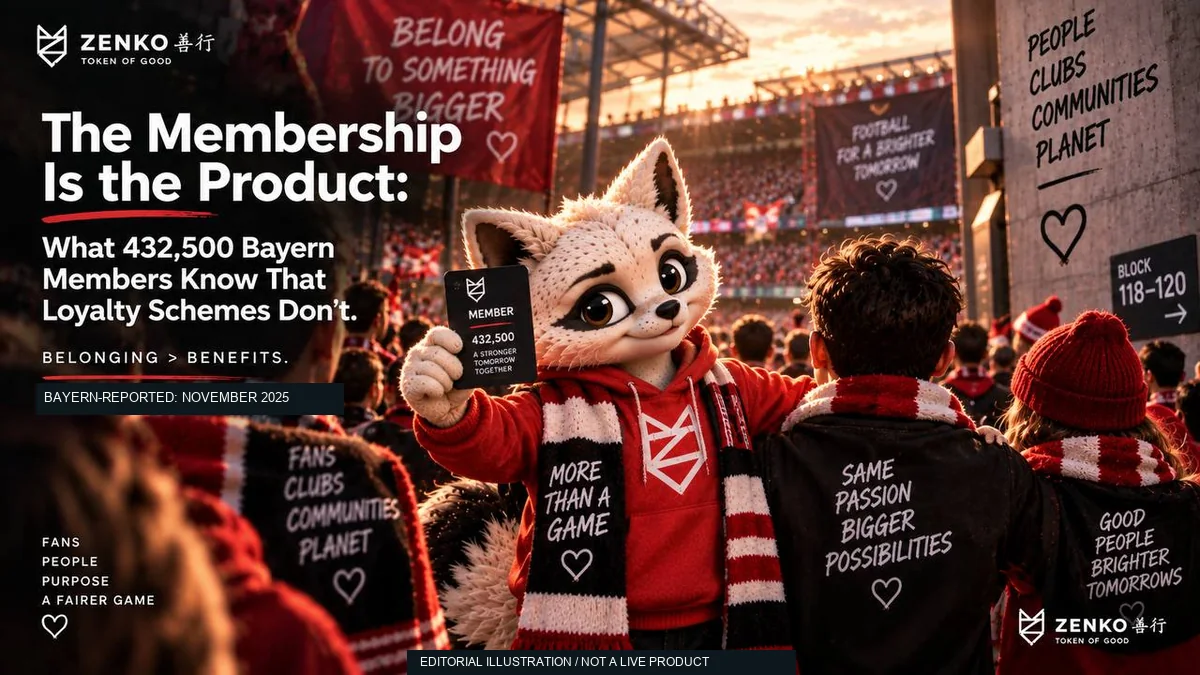
Editorial illustration, not a live product screen or measured performance chart. The 432,500 membership figure was reported by Bayern in November 2025; the card is illustrative.
Fans will pay to belong. A discount alone gives them a reason to shop, not necessarily a reason to stay. The largest membership programmes in sport make identity tangible. That is the wrapper for the fan engagement calendar: a relationship that exists between purchases as well as during them.
The Bayern number
Bayern Munich reported 432,500 members in November 2025, up about 50,000 in a year. Associated Press reporting records president Herbert Hainer announcing the figure. It is a dated membership count, not a claim about today's world ranking or how much every member pays.
The point is not that benefits have no value. It is that a membership offers a way to say: I belong here. A ticket priority window or a shop discount can support that relationship. Neither is a substitute for it.
Be careful turning the member count into a revenue headline. Even a flat-rate illustration of 432,500 members at €60 would produce €25.95m. That is arithmetic, not Bayern's reported membership revenue: fee categories, concessions and the actual paying-member mix matter. Do not put it in a forecast without the fee data.
Why belonging beats perks
Social identity theory is a useful lens: supporting a club can become part of how someone describes themselves. Family, friends, geography and shared experiences can all matter. That is a stronger design starting point than assuming the latest discount creates the relationship.
Paying to be a member can reinforce that identity: I am the kind of person who belongs here. It does not prove that every member stays for life. A discount rewards a transaction; a good membership gives the supporter reasons to keep participating.
Loyalty in sport works when it deepens identity and access. It fails when it is a generic coupon with a crest on it.
The access problem: the best seats go to sponsors
Ask any fan what they would pay for and "closer to the action" is near the top. Ask what the club sells and the answer is the same thing, to a corporate. Paddock passes, tunnel access, behind-the-scenes, meet-and-greets: disproportionately allocated to sponsors and hospitality rather than distributed to ordinary supporters.
The practical alternative is to make some scarce access available through participation, using clearly explained eligibility and ballot rules. A fan who contributes regularly could get a chance at an experience that would otherwise sit entirely inside hospitality. The access must be real and the rules approved before the promise goes out.
The cause layer: giving the membership a moral dimension
A membership that only gives things to the fan is a subscription. A membership that lets the fan give something through the club is an identity.
The precedents are already in football: club foundations, supporter fundraising and merchandise-linked programmes. The MK Dons shirt initiative gives us a concrete example. Contribution becomes more credible when the supporter can see the funding commitment and the delivery evidence, not just a cause logo.
Fans contributing through the club is not new. Making it visible, regular and meaningful to the fans is the design opportunity. That is the part of a membership a discount cannot copy.
A membership framework: identity, access, contribution
Build tiers on three things, none of which is a percentage off.
Identity. A number, a card, a squad, a place on a leaderboard, a collectible that proves you were there. The things that make a fan say "member" rather than "customer".
Access. Ballots for the scarce experiences, weighted by participation rather than spend, so a fan who has played every week has a real chance at the tunnel.
Contribution. A visible, fan-directed stake in what the club does for its city, counted in outcomes rather than pounds. Fans decide which community project the week's pool supports and see it delivered.
The last of these is where clubs get nervous, usually because previous attempts leaned on speculative tokens and the reputational risk that came with them. Fan Tokens, NFTs and the Bust is the honest version of that history and what survived it.
Where Zenko fits
The MK Dons Buy a Home Shirt, Feed a Child programme shows the contribution layer in practice. The club's 17 July 2026 announcement reports 2,000 meals' worth of fresh produce delivered through four Milton Keynes hubs, with Surplus to Purpose preparing and delivering it. It is a merchandise programme, not evidence that a complete membership platform or collectible claim flow has launched. Read the re:Hunger delivery case study.
A broader Zenko programme could add identity, access and redemption around that contribution. Squads, leaderboards, mission-earned ballots and participation records remain design options to scope with the club. Product readiness, reward terms, privacy roles and any data export must be confirmed before selling them as a joined-up service.
FAQ
Which sports club has the most members? Counts and membership definitions change. Bayern reported 432,500 members in November 2025. That is a useful dated example, but it is not enough to establish the current global ranking across clubs with different membership categories.
Why do fans join club membership schemes? Belonging, access, identity and practical benefits can all matter. Ask members which of those they value rather than assuming a discount is the main reason they joined.
What is the difference between a fan loyalty programme and a membership? A transaction-led loyalty programme usually rewards spending. A membership can also offer identity, status, access and a voice. The categories overlap; the useful question is whether the programme creates reasons to participate beyond the next purchase.
How do football clubs raise money for community causes? Through foundations, collections, merchandise-linked contributions and other agreed funding programmes. Make the commitment and delivery evidence visible, and distinguish funded outcomes from outcomes already delivered.
Start with your calendar
Request a fan engagement calendar audit. Bring the fixture list and the gap you want to fix.