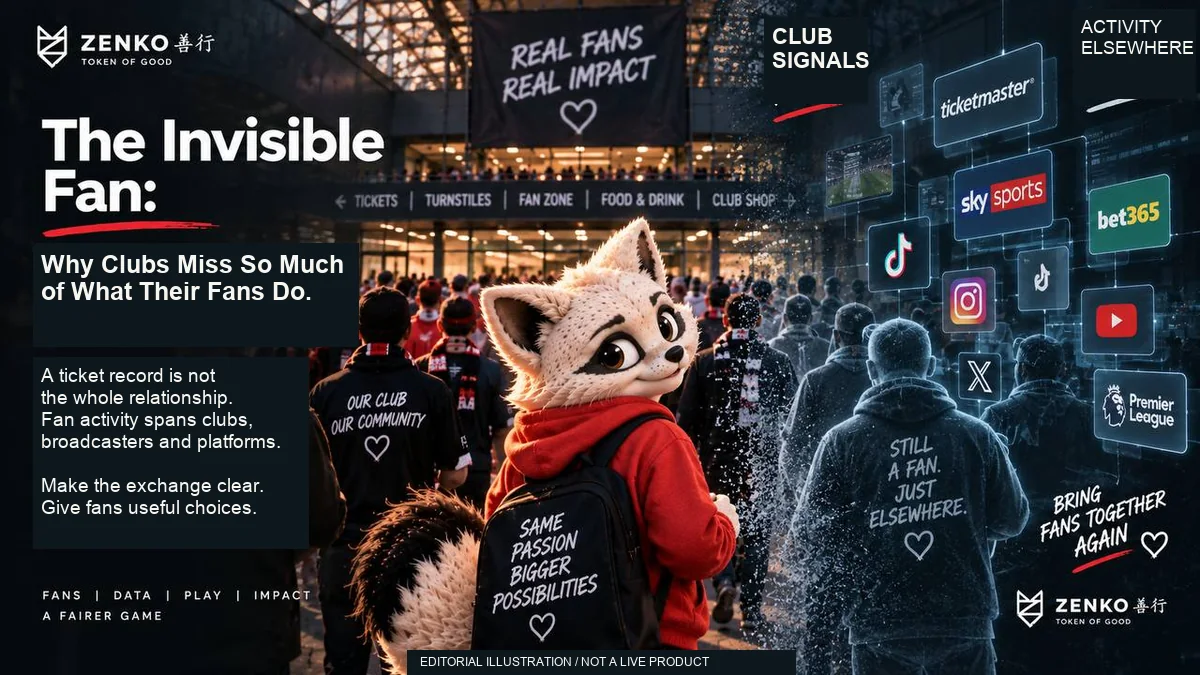
Editorial illustration, not a live product screen or measured performance chart. Third-party services are shown as context, not as Zenko partners.
A club can know a supporter's seat and still know almost nothing about their Wednesday. WSC Sports, citing JohnWallStreet, estimates that sports organisations capture around 40 to 50 per cent of fan interactions. That is an industry estimate, not a measured rate for every club or a percentage of unique fans. It explains a useful problem in the fan engagement calendar: much of the relationship happens somewhere else.
Where the unseen activity goes
A fan who watches highlights on YouTube, shares a clip on social, uses a third-party app and buys a shirt through a marketplace may have several meaningful interactions with the club without producing a joined-up club record. Whether the club receives any of those signals depends on contracts, integrations and the fan's permissions.
Attention and transactions pass through different systems. A ticketing provider may share purchase records with the club. A broadcaster or social platform may provide only aggregate reporting. The issue is not that every third party hides everything; it is that a ticket history is not a complete picture of a supporter.
The direct-to-consumer reflex, and why it is not enough
Rights holders know this, and the response for the last five years has been to go direct. Club apps. Owned streaming. Membership platforms.
Owned channels can help. They do not automatically make a direct-to-consumer service profitable, and a streaming app does not fill a midweek with no fixture. Direct distribution and a reason to return are different problems. Build both, rather than assuming an app has solved the relationship.
There is also a plumbing problem nobody puts in the strategy deck. Customer data platforms and identity systems can help join fragmented records, but the work needs clear purposes, accurate matching and appropriate permissions. First-party does not mean exempt from privacy obligations. A clean, useful data model matters more than buying the biggest CDP.
Gamification is a data engine that fans opt into
Play can generate useful first-party signals. A prediction, squad choice or cause preference tells the club something, provided the programme explains what is collected and how it will be used. MoZeus reports data opt-in of 80 per cent-plus for FanPlay. That is vendor-reported, not a universal consent benchmark or evidence that games always outperform a preference centre.
A preference intentionally shared by a fan is often called zero-party data. Observed behaviour in an app is first-party behavioural data. They are not the same, and either can involve tracking. Separate participation from optional marketing permissions and make the choice clear. Half-Time Is Not Dead Time covers mechanics that could generate useful signals on matchday.
Three questions to ask your own data
Before buying anything, run these against what you hold today.
What do you know about a fan at 3pm on a Wednesday that you did not know at 5pm on Saturday? If the answer is nothing, your data model is a matchday model.
Can you explain why each signal is collected and how it may be used? Separate declared preferences, observed behaviour and inferred attributes. Ask the privacy owner to approve the purposes and permissions rather than assuming that an identified record is automatically compliant.
Can you act on a signal within 48 hours? Data you cannot act on before the next fixture is a report, not an asset. The value of knowing a fan chose the community foundation over the academy is that you can talk to them about the foundation before Saturday.
Where Zenko fits
The proposed Zenko model could record actions such as joining a squad, choosing a cause or completing a mission. Before launch, the club and delivery partners need to agree data-controller and processor roles, permitted uses, export rights, retention and the integration specification. Do not assume that a standard CRM connection or universal ownership of every event comes with the programme. For the commercial side of this issue, read first-party fan data.
A membership programme can give those signals a useful home. The exchange still needs to be clear: what the fan gets, what they share and which choices remain optional. Belonging is not blanket permission to market.
FAQ
What is first-party data in sports? First-party data is information a club collects directly from its own fans through owned channels: ticketing, membership, apps, games and email. It contrasts with data held by third parties such as broadcasters, betting operators and social platforms.
Why do sports clubs struggle with fan data? Fan activity spans club systems, broadcasters, social platforms and other services. WSC Sports cites an industry estimate of 40 to 50 per cent visibility of interactions, but clubs should measure their own coverage. Joining records also requires sound identity matching and approved data use.
What is zero-party data? It is a common industry term for information someone intentionally shares, such as a preference or cause choice. It is not a separate legal exemption, and intentional disclosure does not guarantee accuracy or permit every later use.
How can football clubs collect fan data ethically? Explain the exchange, collect only what is needed, make optional permissions clear and give people useful controls. A game or mission should deliver value to the fan, not disguise a demand for unrelated marketing consent.
Start with your calendar
Request a fan engagement calendar audit. Bring the fixture list and the gap you want to fix.