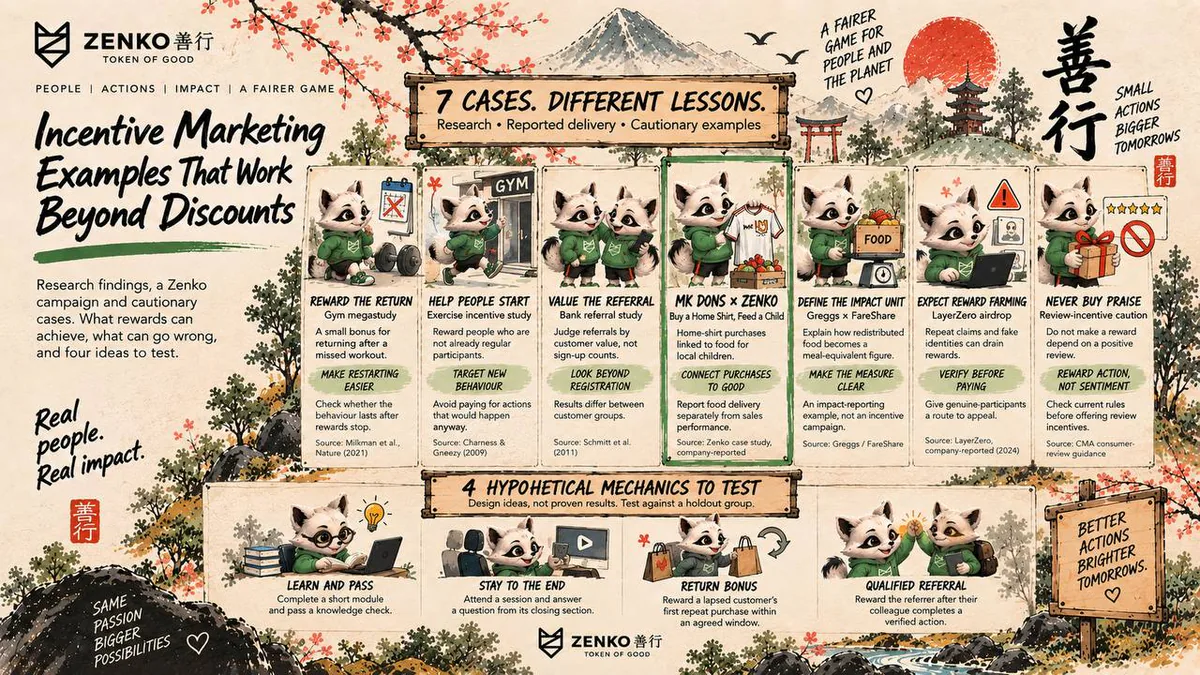
Research, company-reported delivery and cautionary cases, followed by four hypothetical mechanics. See the evidence and limits below. Open the full-size illustration.
The best-documented examples of rewards changing behaviour pay for a specific action, keep the reward small, verify before paying and measure afterwards. Below are seven documented cases with their sources and limits, then four hypothetical mechanics worth testing. We label which is which, and we do not present a company's own report as independent evidence.
Each case shows one part of rewards-based marketing at work, or failing.
Documented examples
1. Returning after a missed workout (gym megastudy)
- Source type: peer-reviewed field study
- Action rewarded: gym visits, tested across 54 four-week programmes with 61,293 members
- Reward: small monetary rewards
- Reported result: 45% of programmes raised weekly visits by 9% to 27% while they ran, and 8% still showed a measurable effect afterwards (Milkman et al., Nature, 2021)
- Lesson: reward the restart, and plan the exit. Small rewards changed behaviour for the length of a programme, and rarely beyond it.
2. Paying people to start going to the gym
- Source type: peer-reviewed field study
- Action rewarded: attending a gym for a month
- Reported result: attendance stayed higher after the payments ended, and the gain came entirely from people who had not attended regularly before (Charness and Gneezy, Econometrica, 2009)
- Limits: small samples
- Lesson: aim rewards at people who are not yet doing the thing.
3. A bank's referral programme
- Source type: peer-reviewed study of about 10,000 customers over almost three years
- Action rewarded: referring a customer
- Reported result: referred customers were at least 16% more valuable, their margin advantage eroded, their retention advantage persisted, and the gap varied by segment (Schmitt, Skiera and Van den Bulte, Journal of Marketing, 2011)
- Lesson: value a referral by segment, and pay on the referred customer's qualified action.
4. MK Dons: Buy a Home Shirt, Feed a Child
- Source type: company-reported, and Zenko is the company
- Action rewarded: buying a home shirt
- Reward: a reward for good, a meal's worth of food for projects feeding children in food poverty in Milton Keynes
- Reported result: 2,000 meals' worth of fresh produce delivered through four local hubs, set out in Zenko's case study of the MK Dons programme
- Limits: this is a delivery result. It does not show the programme raised shirt sales, and a meal's worth is a weight convention, not a count of plates.
- Lesson: report delivery in stages, state the unit, and do not claim a sales effect you have not measured.
5. Stating a unit clearly (Greggs and FareShare)
- Source type: company-reported
- What it is: not an incentive campaign, but a clean model of how to state an impact unit
- Reported result: Greggs reported 420 tonnes of food redistributed through FareShare and described it as the equivalent of more than one million meals (Greggs), which is 420g a meal, the convention FareShare uses
- Lesson: publish the conversion, so a reader can check the arithmetic.
6. Cautionary: airdrop farming
- Source type: company-reported
- Reported result: LayerZero reported 803,093 potential sybil addresses in its 2024 airdrop, and ran a self-report phase in which people who came forward received 15% of their intended allocation (LayerZero, May 2024)
- Lesson: transferable rewards attract farming, and filters catch real people, so build the appeal first. The controls are in how to prevent reward farming without punishing real customers.
7. Cautionary: discounts for five-star reviews
- Source type: official regulator investigation
- What was reported: in March 2026 the CMA opened an investigation into alleged undisclosed discounts for five-star reviews at Pasta Evangelists. As at 28 September 2026, the official case page remains open and publishes no finding of infringement
- Lesson: never make a reward depend on sentiment. Read the CMA guidance before asking for reviews at all.
Four hypothetical mechanics to test
These are design ideas, not results. Nobody has measured them here, and each needs a holdout group. Score each against the matrix in How to Choose the Right Customer Action to Reward.
| Mechanic | Action | Verification | Reward | Measure | Main risk |
|---|---|---|---|---|---|
| Learn and pass | Complete a short module and pass a check | Completion and score logged by the platform | Access reward plus a reward for good | Demo requests and repeat use at days 60 and 120 | Click-through without learning |
| Stay to the end | Attend a live session and answer a question drawn from the last ten minutes | The answer, checked by the system | Access or recognition reward | Attendance quality and follow-on action | Shared answers |
| Return bonus | A lapsed customer makes a first repeat purchase inside an agreed window | Purchase record | A small benefit | Repeat rate against the holdout | Pulling forward purchases that would have happened |
| Colleague referral | A colleague completes a qualified action | The colleague's verified action | Reward paid on the colleague's action | Value by segment | Referral rings |
Design lessons to take from these examples
- Keep the reward small or proportionate to the effort.
- Check the action before paying the reward.
- Measure behaviour after the reward, not only during it.
- State the limits when reporting a result.
Where Zenko fits
If you want to test one of the mechanics above with Zenko, scope the action, reward, verification and required integration first. Learning, movement, shopping and play are possible action families, not a guarantee that every proposed mechanic is available today.
The MK Dons programme is the documented purchase-linked example: shirt sales linked to food for local children, with delivery reported in Zenko's case study. It does not establish a sales uplift or prove the same results for another campaign.
For a mechanic that is new to you, start with one action and a holdout group, so you learn what it does before expanding it. How to Measure a Rewards-Based Campaign shows how.
If you are planning a brand or sports programme, see our page for brands.
Tell us the action you want to reward and the outcome you need. We will show you how a campaign could work.
Plan a rewards-based campaign with Zenko
Frequently asked questions
What are examples of incentive marketing?
Documented examples include small rewards for returning to the gym, paying customers to start an activity, referral programmes and purchase-linked donations. Discounts are the best-known form, but rewards for learning, attendance, return visits and qualified referrals can be more useful because they target a chosen behaviour.
Do incentives have to be discounts?
No. A reward can be a benefit, access, recognition or a contribution to a cause. Which one works best is an empirical question, so test it against another reward with a holdout group.
Do incentive marketing campaigns work?
They can increase a first action while the reward runs, but not every intervention works. The evidence for lasting behaviour change is weaker: in the largest gym study, only 8% of programmes still showed an effect after they ended. Measure both periods.
Are referral incentives worth it?
They can be. In a study of about 10,000 bank customers, referred customers were at least 16% more valuable, though part of that advantage faded and varied by segment. Pay on the referred customer's qualified action, and check results by segment.
Sources
- Milkman et al., Nature, 2021
- Charness and Gneezy, Econometrica, 2009
- Schmitt, Skiera and Van den Bulte, Journal of Marketing, 2011
- Zenko case study of the MK Dons programme (company-reported)
- Greggs and FareShare (company-reported)
- LayerZero, sybil self-report update, May 2024 (company-reported)
- CMA, Pasta Evangelists consumer protection enforcement case
- CMA guidance on publishing consumer reviews
In this rewards-based marketing series
- Rewards-Based Marketing: How to Reward Actions That Actually Matter
- How to Choose the Right Customer Action to Reward
- How to Measure a Rewards-Based Campaign
- How to Prevent Reward Farming Without Punishing Real Customers
Related acquisition measurement
Related acquisition measurement: compare marketing channels at matched pipeline age.