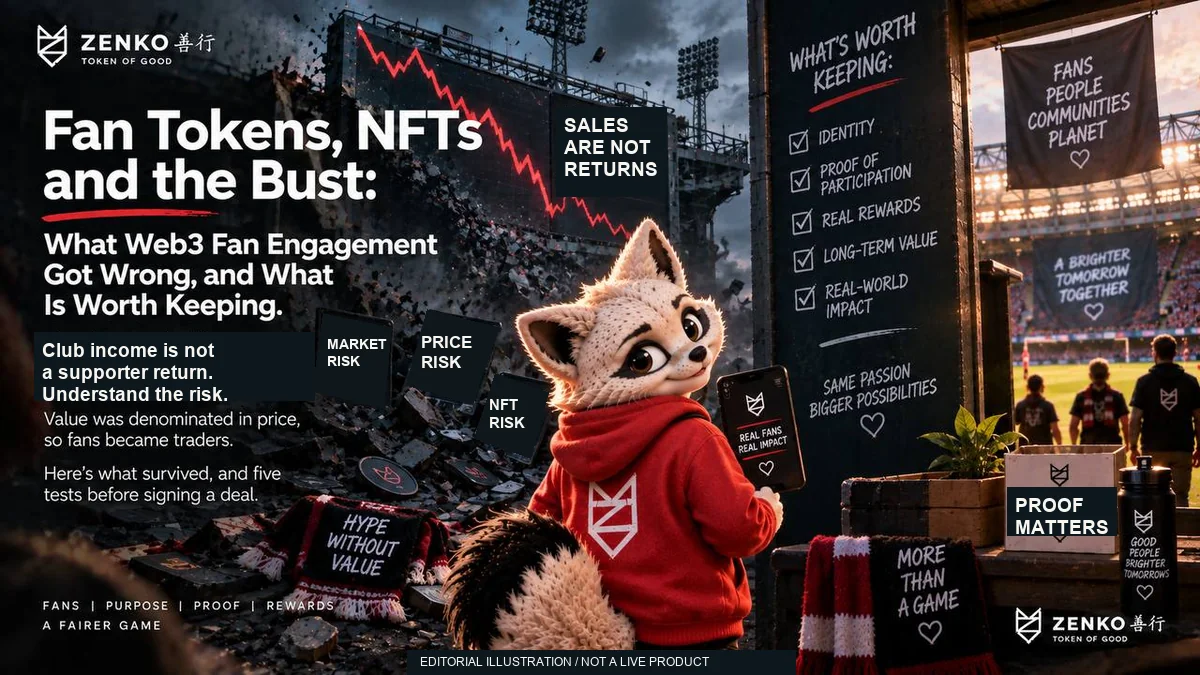
Editorial illustration, not a live product screen or measured performance chart.
Web3 fan engagement brought income to sports organisations and exposed supporters to market risk. Both belong in the conversation. Any club pitched a token should ask what the fan actually gets and what can go wrong. This is the honest version from a company building in the space, and the five tests I would apply to any deal, including ours. It closes the fan engagement calendar series because technology should serve the membership, not replace it.
What worked, with the asterisk attached
Chiliz says fan tokens have generated more than $700 million in new income for sports organisations. That is an attributed company claim. It is not a verified figure for recurring revenue, company profit or supporters' investment returns.
The asterisk matters. A headline about money reaching sports organisations does not tell a club what a new programme will earn, or tell a supporter what a token will be worth. Ask for the definitions, reporting period and contractual economics behind the sales pitch.
What failed
Saggu, Ante and Demir's 2024 study examines anticipatory gains and event-driven losses in fan tokens around the FIFA World Cup. Keep that scope: it is not proof that every club token moves the same way after every result. It does show why clubs should take market exposure seriously when a fan relationship is packaged as a tradeable asset.
Sales volume, collectible prices and a holder's return are different measures. A club should not use a sales chart to imply that every supporter had the same investment outcome.
The diagnosis is simple. Value was denominated in price. When price is the product, every fan is a speculator and every downturn is a betrayal.
For the earlier commercial history, read whether fan tokens work for clubs. This article adds a calendar and membership decision lens rather than repeating the market-sizing case.
What is worth keeping
Underneath the speculation, three ideas survived and are now the useful part of the toolkit.
Portable identity. A fan ID that can work across agreed services could prevent membership being trapped in one app. Portability still depends on interoperability, permissions and commercial agreements; putting something on-chain does not create those automatically.
Proof of participation. A collectible that says "I was there, I did this" can be a useful receipt. Its evidence is only as good as the recorded event. It is not, by itself, proof that a meal was delivered or a community outcome happened.
Rewards with clear terms. Fans should know what a reward can be redeemed for, when it expires and what can change. On-chain records do not guarantee stable value. The useful design is understandable utility without a speculative pitch.
Five tests before a club signs a Web3 deal
Is value denominated in outcomes and access, or in price? If a fan's reward can go down in value because the team lost, walk away.
Can the fan lose money? If the answer is yes, stop treating this as an ordinary loyalty pitch. Get qualified advice on the exact structure, jurisdiction, disclosures and audience. This article does not classify it legally.
Who holds the downside? A minimum guarantee is a contract, not a marketing adjective. Check the amount, conditions, funding, counterparty and remedies if it is missed. Do not confuse a proposed underwriting model with secured money.
Is it gated where it needs to be? A football audience includes children. Set eligibility, safeguarding and any age checks around the actual mechanics, rewards and jurisdictions, with qualified review. An 18-plus gate is not a blanket legal answer.
Can the club leave with the agreed data? Specify export rights, permitted uses, privacy roles and practical exit arrangements in the contract. The Invisible Fan explains why that belongs in the commercial decision.
Where Zenko fits: built after the bust
Those tests are the standard I would apply to Zenko too. The intended design is participation, clear rewards and evidence of outcomes, not a promise of returns.
For a new sports programme, fixed-value reward language, redemption terms, age eligibility, data integration and any underwriting remain matters to confirm before launch. Where an outcome pool is proposed, secure the funding first and report allocation separately from delivery. Where a collectible is proposed, explain the participation it records without implying it guarantees physical impact. The documented MK Dons merchandise programme is a proof point for delivered produce, not proof that every part of a new membership system is live.
The membership stays the product. The Membership Is the Product is the version of this argument without any of the technology in it, which is roughly how much a fan needs to see.
FAQ
What are fan tokens? Fan tokens are digital assets, usually issued through platforms such as Socios, that give holders voting rights on minor club decisions, access to rewards and experiences, and a tradeable asset whose price moves with demand.
Are fan tokens a good investment? They can expose holders to volatile market prices. The 2024 Saggu, Ante and Demir study examines event-linked behaviour around the FIFA World Cup, not guaranteed outcomes for individual tokens. This is general information, not financial advice.
What should clubs learn from sports NFT sales charts? Sales volume measures trading activity, not a uniform change in collectible prices or every holder's return. Ask which dates and metric a chart uses before treating it as evidence of supporter outcomes.
How much money have fan tokens made for clubs? Chiliz claims more than $700 million in new income for sports organisations. Attribute that to the company and do not present it as independently verified recurring revenue or a forecast for a new club deal.
Start with your calendar
Request a fan engagement calendar audit. Bring the fixture list and the gap you want to fix.