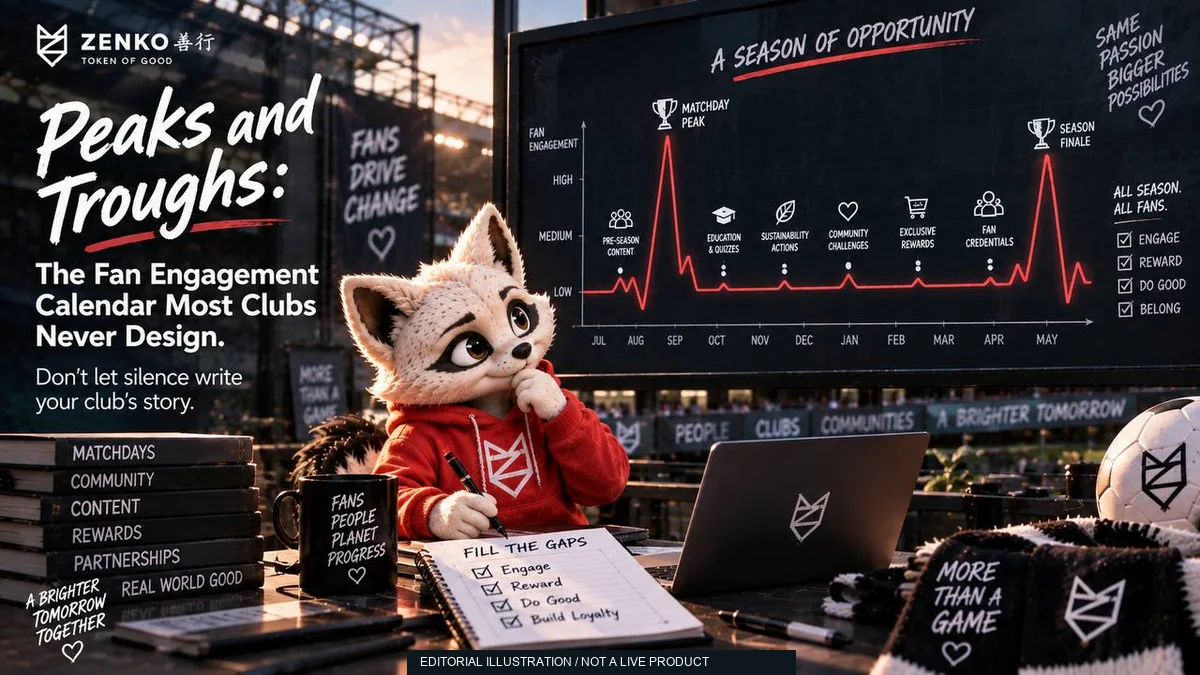
Editorial illustration, not a live product screen or measured performance chart.
Most clubs run fan engagement with one setting: matchday. The fan gets a peak on Saturday at 3pm, a trough by 5pm (deeper after a loss), and the club's next touchpoint is an email about tickets for Tuesday. Research on memory gives us a reason to question that design: peaks and endings can weigh heavily in how people remember an experience. That is a useful design lens, not proof that every fan remembers a season in the same way. If the ending is a transactional email and the next peak is a fortnight away, the club is letting silence do too much of the work.
The fix is not more content. It is a calendar. Map where the peaks are, be honest about where the troughs are, and put something the fan actually wants in each trough. This piece is the map. The six pieces linked from it go deep on each part of the argument.
The shape of a season, drawn honestly
Draw a fan's emotional line across a fortnight and it looks like a heart monitor with a fault. One spike on matchday. A sharp drop at the final whistle. Then a flat line until the next fixture, interrupted by whatever the ticketing system decides to send.
That shape matters because of how memory works. In their 1993 research, Daniel Kahneman, Barbara Fredrickson and colleagues showed that peaks and endings can carry disproportionate weight in retrospective evaluations. The experiments were not football-season trials. Applying the idea to sport is a design hypothesis worth testing. I cover the science and what it means for the final whistle in The Peak-End Rule in Sport.
Sport is very good at the peak. The ending deserves the same care. Fan psychology research describes CORFing, cutting off reflected failure, where some fans distance themselves from a team after defeat. Strongly identified supporters do not all respond that way. The practical point is to design a loss message that respects the fan rather than assuming another sales email will do.
Why the trough is a design failure, not a loyalty failure
Clubs tend to read the silence as fan apathy. The evidence points the other way.
WSC Sports, citing JohnWallStreet, estimates that sports organisations capture around 40 to 50 per cent of fan interactions. This is an industry estimate, not an audited benchmark for every club, and interactions are not the same thing as unique fans. Much of the activity sits with broadcasters, social networks and other platforms. I unpack that gap in The Invisible Fan.
The demand is there. Altman Solon's 2025 Global Sports Survey, fielded in December 2025, found that 39 per cent of 18 to 24 year olds typically watch an entire event, against 61 per cent of fans aged 65 and over. Deloitte's 2023 US research describes fans doing other game-related activities while watching at home. Those are different measures, not interchangeable second-screen rates. They suggest an opportunity to offer something useful in the gaps. Half-Time Is Not Dead Time covers the in-match version.
So the trough is not the fans' fault. It is what happens when the only product on the shelf is a ticket.
What fans actually want: six things, three states
Strip the research down and fans want six things from a club:
- To be part of the tribe. Identity can come from family, place and shared rituals, not just winning.
- To be rewarded in ways that deepen identity and access rather than a generic discount.
- To be entertained, especially in the gaps.
- To get things first: drops, kit, access.
- To be known, with a clear choice about what they share.
- To get closer to the action, including experiences often packaged for sponsors and hospitality buyers.
And they want those things in three different states: at the ground, watching from home, and in between. Audit how much of your own budget serves each state. The third is where the calendar lives.
The calendar overlay
This is the single most useful exercise I do with a club. Print the season. Mark every week where the only touchpoint is transactional. Then overlay a peak for each trough.
| Calendar moment | What most clubs do | The peak to engineer |
|---|---|---|
| Pre-match | Team news, ticket push | Predictions and squad picks that carry into the match |
| In play | Nothing between whistles | Half-time, VAR and stoppage mechanics |
| Post-match | "Tickets for Tuesday" | A personal closing beat that lands even after a loss |
| Midweek | Silence or generic content | A two-minute daily habit with a streak |
| International break | Silence | A collective mission with a visible finish line |
| Transfer window | Rumour content | Free-to-play prediction on signings |
| Kit launch | Shop email | An agreed merchandise contribution with visible delivery evidence |
| Pre-season | Fixture list | Access ballots earned through participation |
| Off-season | Nothing | A community mission that runs all summer |
None of these require a documentary. Drive to Survive and Welcome to Wrexham show how off-field storytelling can sit alongside audience and commercial growth. Wrexham's sponsorship and advertising revenue rose from £1.883m to £13.181m between FY2023 and FY2024, according to its accounts. That does not isolate the documentary's contribution from promotion, ownership and new partnerships. Always-On Fandom looks at what transfers to clubs without Hollywood owners.
Membership is the wrapper, not the discount
The thing that holds a full-calendar model together is membership, and the evidence says the membership itself is the product.
Bayern Munich reported 432,500 members in November 2025, up about 50,000 in a year. That is a dated club-reported figure, not a current world ranking. The argument is bigger than the number: membership can make belonging tangible, rather than treating a supporter as a sequence of purchases. The Membership Is the Product goes through the model and why discounts alone struggle to build it.
A cause layer can make the membership mean something beyond the member's perks. Fans contributing through a club is not new. Making the funding, fan choices and delivered outcomes visible in the weekly rhythm is the useful design challenge.
Where Zenko fits in the calendar
Zenko's role is to connect participation with funded outcomes. A full-calendar programme could combine prediction games, a daily habit, distance missions and merchandise-linked good. The mix is scoped for each club; it is not a ready-made bundle of every integration. The sports proposition and brand programme page explain the approach; product availability, funding and delivery terms need agreeing for each club.
Three things need to be settled commercially before a rights holder launches.
First, fund the outcome before promising it. A sponsor or club could commit a defined pool, with participation directing an agreed allocation. Fans would be given a say over something already funded, not told that a tap somehow created a meal. Report funding, allocation and physical delivery as separate stages.
Second, agree the data arrangement. A fan who joins a squad, picks a cause or completes a mission can provide a useful signal. What is collected, the lawful basis, permissions, retention and any CRM integration must be specified, not assumed.
Third, document who carries the commercial risk. A proposed underwriting arrangement is not a funded guarantee. Any minimum commitment needs signed terms and evidence of the counterparty's ability to meet it. That distinction matters because Web3 fan engagement got this wrong for years. I explain what is worth keeping in Fan Tokens, NFTs and the Bust.
The established proof point is the MK Dons Buy a Home Shirt, Feed a Child programme. The club's 17 July 2026 announcement reports 2,000 meals' worth of fresh fruit and vegetables delivered through four Milton Keynes community hubs, with Surplus to Purpose preparing and delivering the produce. That is not a claim about 2,000 individual children or a live match-prediction product. Read the re:Hunger delivery case study.
Zenko is not the broadcast, ticketing system or personalised highlight. Those are separate services; any connection to them needs its own agreed integration.
Start with a calendar audit
If you take one thing from this piece, take the exercise. Print the season. Mark the silent weeks. Then stage the fix.
Phase 1: matchday. Test a suitable participation mechanic and rewrite the post-match message so the club owns its follow-up. Phase 2: between matches. Add a daily habit or collective mission once the first test earns repeat participation. Phase 3: membership. Wrap it in identity, access and contribution, with the data and delivery arrangements documented.
Set benchmarks before moving between phases. MoZeus reports 80 per cent-plus data opt-in and 8 to 12 minutes of dwell time for FanPlay. These are vendor-reported results, not an independent average, a ceiling or a promise for your club. Agree your own baseline, sample, consent measure and repeat-participation target before launch.
For the commercial context behind the calendar, read who makes money in sports. This cluster owns the participation rhythm; that one follows the money. Bring both, and the fixture list, to the conversation.
Request a fan engagement calendar audit.
FAQ
What is a fan engagement strategy? A fan engagement strategy is a plan for how a club or rights holder creates value for supporters across the whole season, not just on matchday. A good one maps the calendar, identifies where fans are left with nothing to do, and places a product, content or community mechanic in each gap.
How do football clubs engage fans between matches? The clubs that do it well use a mix of free-to-play games, membership programmes, community and cause programmes, personalised content and exclusive access. The common thread is a reason to return that is not a purchase.
Why do fans disengage after a match? There is no single reason. A defeat, an irrelevant follow-up or a lack of anything useful between fixtures can all matter. Some supporters distance themselves after losses; others become more committed. Test the response of your own fans rather than assuming a universal pattern.
What is the peak-end rule in sport? It is the application of a memory-research finding to fan experience design: intense moments and endings can weigh heavily in retrospective judgments. The original experiments were not sports trials, so treat better post-match messages as a design hypothesis to test, not a guaranteed retention formula.