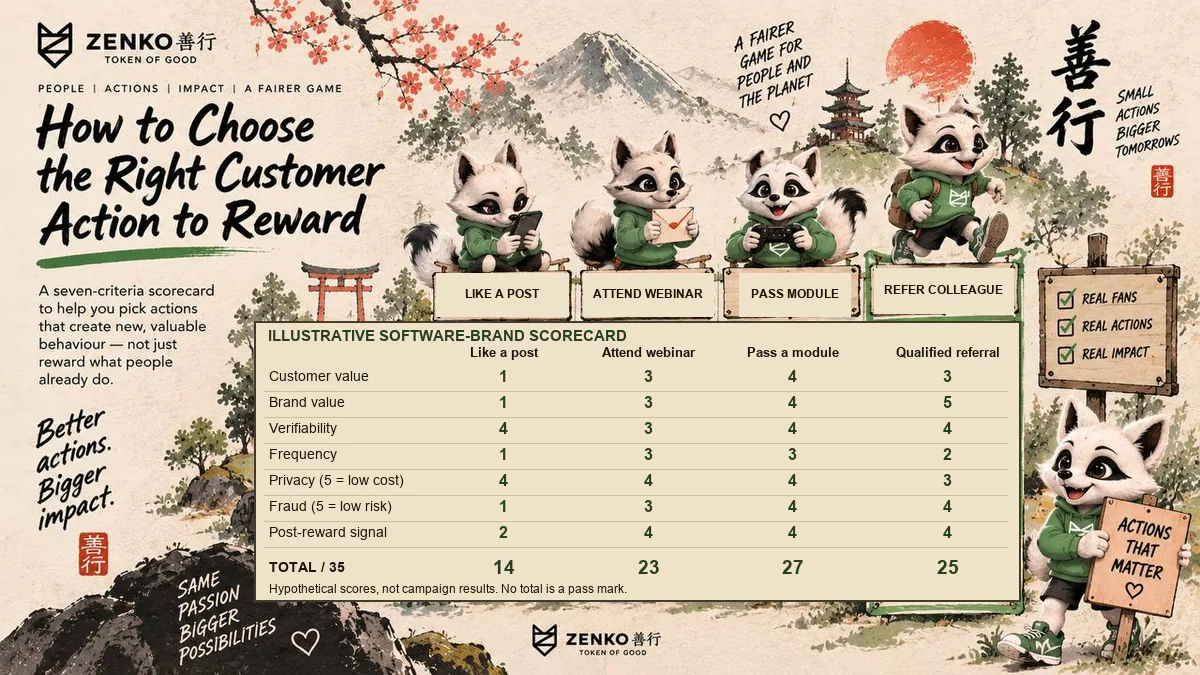
Hypothetical illustration. The example figures match the readable tables below; they are not Zenko campaign results. Open the full-size illustration.
Reward the action that best predicts the outcome you want, that a system can verify with the least personal data, and that people who were not already doing it will take up. Score each candidate on seven criteria and reject any that cannot be verified, or that you cannot observe after the reward ends.
The choice matters more than the size of the reward. It is the first decision in rewards-based marketing, and the one most teams make in a hurry.
Why the action matters more than the reward
Two studies show why. Charness and Gneezy paid people to attend a gym for a month. Attendance stayed higher afterwards, but the gain came entirely from people who had not attended regularly before (Econometrica, 2009). An incentive works best on people who were not already doing the thing.
Schmitt, Skiera and Van den Bulte followed about 10,000 customers of a German bank for almost three years. Customers who came through a referral programme were at least 16% more valuable, but their margin advantage eroded over time, their retention advantage persisted, and the gap varied by customer segment (Journal of Marketing, 2011). Our reading is that referral rewards should be paid on the referred customer's qualified action rather than on the sign-up, and that you should watch results by segment.
The seven criteria
Score each candidate action from 1 to 5. For privacy cost and fraud risk, 5 means low cost and low risk.
| Criterion | The question | A score of 5 | A score of 1 |
|---|---|---|---|
| Value to the customer | Is the customer better off for doing it? | They learn something, save time or get something useful anyway | A chore done only for the payout |
| Value to the brand | Does the action predict the outcome you want? | You have evidence linking it to purchase, retention or advocacy | No link beyond a vanity count |
| Verifiability | Can a system confirm it without self-report? | A completion log, purchase record or activity record | The customer says they did it |
| Frequency | Is it a one-off, or can it be repeated? | It fits the natural cycle and can be paced | It can be repeated in seconds |
| Privacy cost | What personal data does verification need? | Minimal, and already held | Sensitive or newly collected |
| Fraud risk | How cheap is it to fake or repeat? | Real effort for every claim | A single click |
| Post-reward signal | Can you see behaviour after the reward ends? | You already track it | You lose sight of the customer once paid |
Reject any action that scores 1 on verifiability or on the post-reward signal. A reward you cannot verify invites farming, and a reward you cannot follow up leaves you unable to say whether it did anything.
A scored example
A UK software brand wants more demo requests and lists four candidate actions. These scores are illustrative, not Zenko campaign data, and a different brand would score them differently.
| Candidate action | Cust. | Brand | Verif. | Freq. | Privacy | Fraud | Post | Total |
|---|---|---|---|---|---|---|---|---|
| Like a social post | 1 | 1 | 4 | 1 | 4 | 1 | 2 | 14 |
| Attend a webinar and stay 20 minutes | 3 | 3 | 3 | 3 | 4 | 3 | 4 | 23 |
| Complete a product module and pass a check | 4 | 4 | 4 | 3 | 4 | 4 | 4 | 27 |
| Refer a colleague who completes the module | 3 | 5 | 4 | 2 | 3 | 4 | 4 | 25 |
No total is a pass mark. The scores exist to expose weak criteria. The like is easy to verify and easy to repeat, and it says almost nothing about demand. The webinar looks reasonable until you notice that a tab left open counts as attendance. The module and the referral come out ahead, and the referral is better tested after the single-action campaign has shown that the module works.
Four traps
- Rewarding what is easy to count. Clicks and likes are easy to verify and easy to fake. Ease of counting is not a reason to reward something.
- Rewarding your regulars. You pay for behaviour you had already, which is the deadweight problem from the gym evidence above.
- Rewarding the sign-up. Pay on the qualified action that follows, not on the registration.
- Rewarding sentiment. Never make a reward depend on what someone says about you. The CMA opened five investigations into online reviews in March 2026, including one into alleged undisclosed discounts for five-star reviews. As at 28 September 2026, the official case page remains open and publishes no finding of infringement. If you ask customers for reviews, read the CMA guidance first.
Reward the return
The gym megastudy tested 54 programmes on 61,293 members. One of the strongest designs paid a small bonus for coming back after a missed workout (Milkman et al., Nature, 2021). That points to a design rule: where a customer has lapsed, the reward for returning may do more than the reward for continuing. Check whether your action has a natural lapse and a natural return, and score the return as a candidate action of its own.
What to do next
- List five candidate actions, including at least one that rewards a return.
- Score them against the seven criteria and drop anything that scores 1 on verifiability or on the post-reward signal.
- Pick one, and decide how you will measure it before you set the reward. How to Measure a Rewards-Based Campaign covers the formulas and the comparison group.
- Check the fraud score against how to prevent reward farming without punishing real customers.
Where Zenko fits
Learning, movement, shopping and play are four action families to consider with Zenko. Each needs an appropriate record, such as a passed module, a logged activity, a confirmed purchase or a played round. The right integration and its current availability need to be scoped for your campaign; an action family is not a promise that every mechanic is ready to run.
A campaign should agree the brand-funded reward, verification before payout and any contribution to a cause before launch. Our guide to verified real-world actions explains the verification approach.
A cheap lead still needs a good action behind it, which is why this matrix belongs before the discussion about the size of the reward.
Tell us the action you want to reward and the outcome you need. We will show you how a campaign could work.
Plan a rewards-based campaign with Zenko
Frequently asked questions
What is the best action to reward for lead generation?
The best action is one that predicts a qualified lead and that a system can verify, such as completing a product module and passing a short check. Registrations and clicks are cheaper to count but say little about intent and are easier to fake.
How many actions should a rewards campaign reward?
One. A single action keeps verification simple, makes the result easy to read and lets you compare against a holdout group. Add a second action only after the first has shown lift.
Should you reward referrals?
Referrals can be worth rewarding, because referred customers were at least 16% more valuable in one large study of a bank. Pay on the referred customer's qualified action rather than the sign-up, and check results by segment because the advantage varied.
Is rewarding likes and shares a good idea?
Usually not. Likes and shares are easy to fake, weakly linked to purchase and hard to follow up, so they tend to score badly on value to the brand, fraud risk and post-reward signal.
Sources
- Charness and Gneezy, Incentives to Exercise, Econometrica, 2009
- Schmitt, Skiera and Van den Bulte, Referral Programs and Customer Value, Journal of Marketing, 2011
- Milkman et al., Nature, 2021
- CMA, Pasta Evangelists consumer protection enforcement case
- CMA guidance on publishing consumer reviews
In this rewards-based marketing series
- Rewards-Based Marketing: How to Reward Actions That Actually Matter
- How to Measure a Rewards-Based Campaign
- How to Prevent Reward Farming Without Punishing Real Customers
- Incentive Marketing Examples That Work Beyond Discounts
Related acquisition measurement
Related acquisition measurement: compare marketing channels at matched pipeline age.