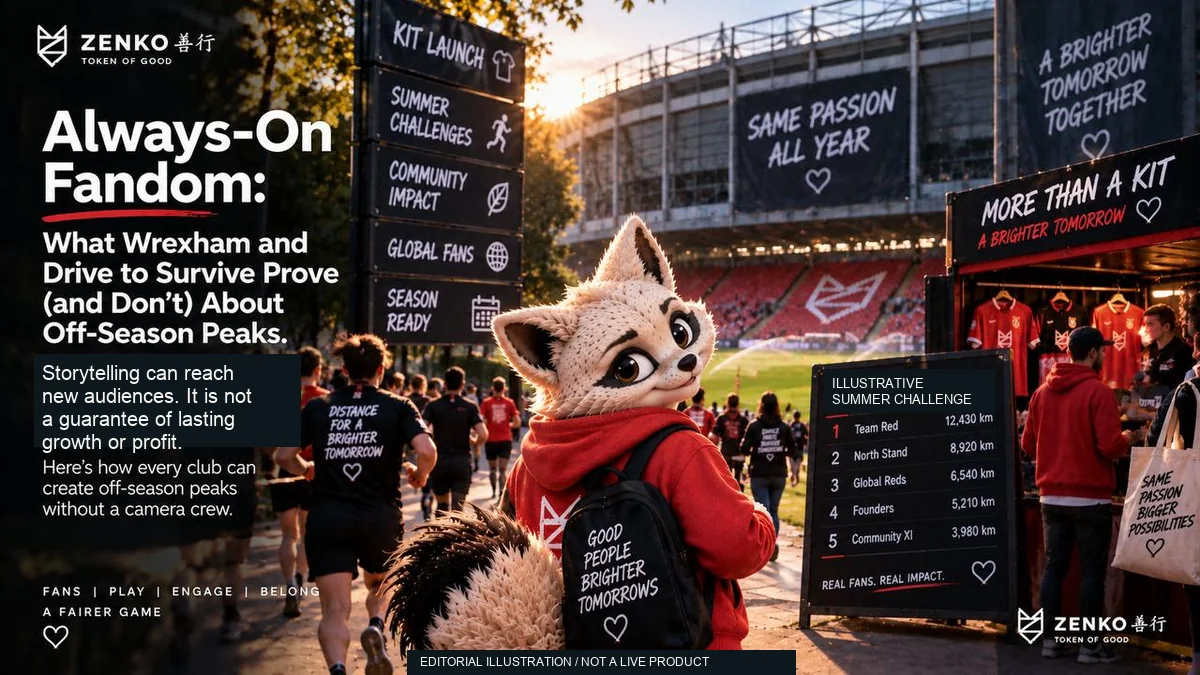
Editorial illustration, not a live product screen or measured performance chart. The summer challenge and leaderboard totals are fictional examples, not recorded results.
Off-field storytelling can build a bigger relationship than the fixture list. Wrexham and Formula 1 give us evidence of audience and commercial growth, but not a clean experiment proving a documentary caused all of it. This piece keeps that distinction and asks what a normal club can build in the deepest troughs of the fan engagement calendar: the international break and the summer.
What the documentaries did
Formula 1's Drive to Survive is the reference case. In Morning Consult's March 2022 survey, 53 per cent of 1,896 self-identified US F1 fans said the show played a role in their becoming a fan. That includes a range of influence; it does not mean the show was the sole cause or that all became regular race viewers. It is self-reported attribution, not a causal experiment.
Wrexham supplies the financial record. Its FY2024 accounts show sponsorship and advertising revenue rising from £1.883m to £13.181m, about 600 per cent. Total turnover rose from £10.478m to £26.725m, about 155 per cent, and reached £33.335m in FY2025. The category matters: £13.181m is sponsorship and advertising, not all commercial revenue. The accounts discuss the documentary alongside ownership, marketing, partnerships and sporting progress. They do not isolate one cause.
The off-season itself has become an event elsewhere. The NFL Draft and NBA free agency create reasons to follow a sport when the games are not being played. A smaller club can borrow that calendar logic without borrowing the production budget.
Where the evidence is weaker than the headlines
I am not going to pretend the story is clean.
The Netflix effect is not one clean number. A survey about why people became fans, a count of documentary viewers and an average live-race audience measure different things. They should not be stacked into a single causal story. A documentary can create a peak. It is not a promise of permanent growth.
Wrexham still lost money. The FY2024 accounts report a £2.729m loss after tax. FY2025 reports a £14.848m operating loss, compared with a £2.024m operating loss in FY2024. Those are different accounting measures, so label them. The club also says the documentary does not generate direct income for it; it supports an international marketing platform. Attention is not the same as profitability.
And the obvious one: most clubs will never have Ryan Reynolds or a global documentary deal. The principle transfers. The budget does not.
What scales down: an off-season peak menu
The useful idea from The Power of Moments is that memorable moments can be designed. These are off-season and break options a club could test without a camera crew.
Kit launch as an outcome event, not a shop email. Link an agreed funding commitment to the launch and report what it delivers for the club's city. If a participation collectible is part of the offer, confirm the claim experience before announcing it. A launch can be more than a transaction in July.
A collective mission with a finish line. Fans in teams walk, run or cycle a shared distance over the summer, club against club or fans against the squad, with a sponsor-funded pool released as milestones fall. It gives a dormant fan base something to do every day for six weeks and a leaderboard to argue about.
Renewal as a moment. Season-ticket and membership renewal is a peak if the club treats it as one: a ballot, a reveal, a squad announcement, not a payment reminder. The Membership Is the Product covers why paying to belong is itself a memory.
Access ballots earned by participation. Distribute the summer's scarce experiences (open training, a tunnel walk, a Q&A) to the fans who took part in the mission, not only to hospitality buyers.
A community foundation season. Publish what the foundation will do in the city over the summer and let fans direct it, week by week. The Heaths call this pride and connection. Clubs call it the bit of the year nobody sees.
Each of these needs a useful ending as well as a peak. The peak-end rule is a design lens to test on a six-week mission, not proof that it works identically to a laboratory experiment.
Where Zenko fits
A team-based movement mission is one possible summer layer for Zenko. Product scope, the current Zenko Move offer, eligibility and any sponsor-funded milestones must be confirmed before a club promises them. The established Shop for Good proof is the MK Dons delivery case study. Do not assume that its funding or delivery terms automatically cover a new mission. The Wrexham lesson is that an off-season peak needs a commercial model, not just a nice launch.
The bigger lesson from Wrexham I would keep: the audience for a club is no longer bounded by its postcode or its fixture list. A collective mission that a fan in Toronto can join on the same leaderboard as a fan in the Kop stand is the affordable version of the same idea.
FAQ
How did Welcome to Wrexham affect the club's revenue? The club describes the documentary as a marketing platform supporting its commercial development, not direct income. Sponsorship and advertising rose from £1.883m in FY2023 to £13.181m in FY2024; total turnover reached £33.335m in FY2025. Those accounts do not isolate the documentary from other contributors, and the club recorded losses.
Did Drive to Survive increase F1 viewership? Morning Consult found that 53 per cent of surveyed US F1 fans said it played a role in their becoming fans in March 2022. That supports an influence on fandom, but it does not establish how much race-viewing growth the series caused.
How do sports teams engage fans in the off-season? Through tent-pole events (drafts, free agency, tours), documentary and behind-the-scenes content, membership renewal campaigns, community programmes and participation challenges that run across the summer.
What is always-on fan engagement? Always-on fan engagement means giving fans reasons to interact with a club across the whole calendar rather than only on matchdays, using content, games, community and membership to fill the gaps between fixtures and across the off-season.
Start with your calendar
Request a fan engagement calendar audit. Bring the fixture list and the gap you want to fix.